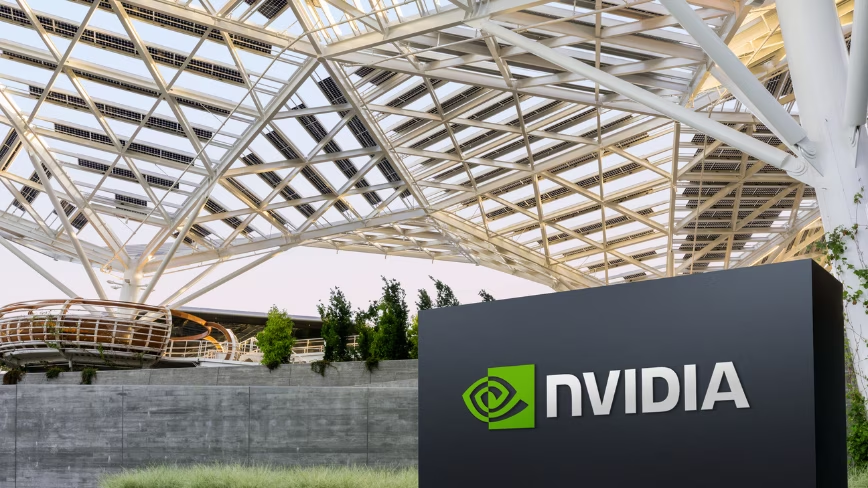
Nvidia is rewriting how AI startups pay for compute. On July 2, 2026 the chipmaker rolled out a revenue-sharing plus credit-support model that lets Nvidia Cloud Partners access Grace-Blackwell and Vera-Rubin GPUs in exchange for a slice of the cloud revenue those chips generate, rather than the full sticker price upfront - a first for a company whose sales strategy has been built on selling silicon outright to hyperscalers.
Vendor Financing With Equity-Like Upside
Nvidia keeps its standard chip revenue and adds a further cut of the compute the partner resells - functioning like vendor financing without touching the customer's cap table. Two anchor deals are already live: Sharon AI is deploying up to 40,000 GB300 GPUs over six years at 72 megawatts, and Firmus is building a 360-megawatt Nvidia DSX AI factory in Batam, Indonesia, that will host up to 170,000 GPUs across Grace-Blackwell, Vera-Rubin and Vera. Bloomberg reports Firmus expects $25B-$30B in offtake commitments over the first six years.
Who The Model Is Actually For
Nvidia named Baseten, Fireworks AI and Together AI as example customers: model builders and agent platforms that need elastic frontier compute without balance-sheet risk. The offer runs on top of Nvidia's DGX Cloud Lepton marketplace, which already links CoreWeave, Crusoe, Nebius, Lambda and Nscale into a single compute exchange for developers building agentic and physical AI.
The $40B Equity Playbook, Now Without Equity
Nvidia has already committed more than $40 billion of direct AI equity in 2026, from OpenAI to Nebius. Revenue-share compute lets it do the same job - subsidize an ecosystem it depends on - without further stretching its own balance sheet. The trade-off: an increasing share of AI cloud growth becomes contractually tied to Nvidia's own success. If AI-native demand ever cools, Nvidia is exposed twice - once through hardware sales and again through the cloud revenue it has agreed to share. The move also sits alongside SpaceX's $6.3B Reflection AI compute deal and AWS's $1B forward-deployed engineers push as evidence infra players are treating GPU access as strategy, not commodity.
Reporting based on coverage from CNBC, Bloomberg and The Next Web.