OpenAI on September 8, 2026 published what it says is an AI-generated resolution of the Navier–Stokes existence and smoothness problem, one of the Clay Mathematics Institute's seven Millennium Prize Problems, complete with an analytical writeup and a machine-checked Lean formalization.
What The Proof Says
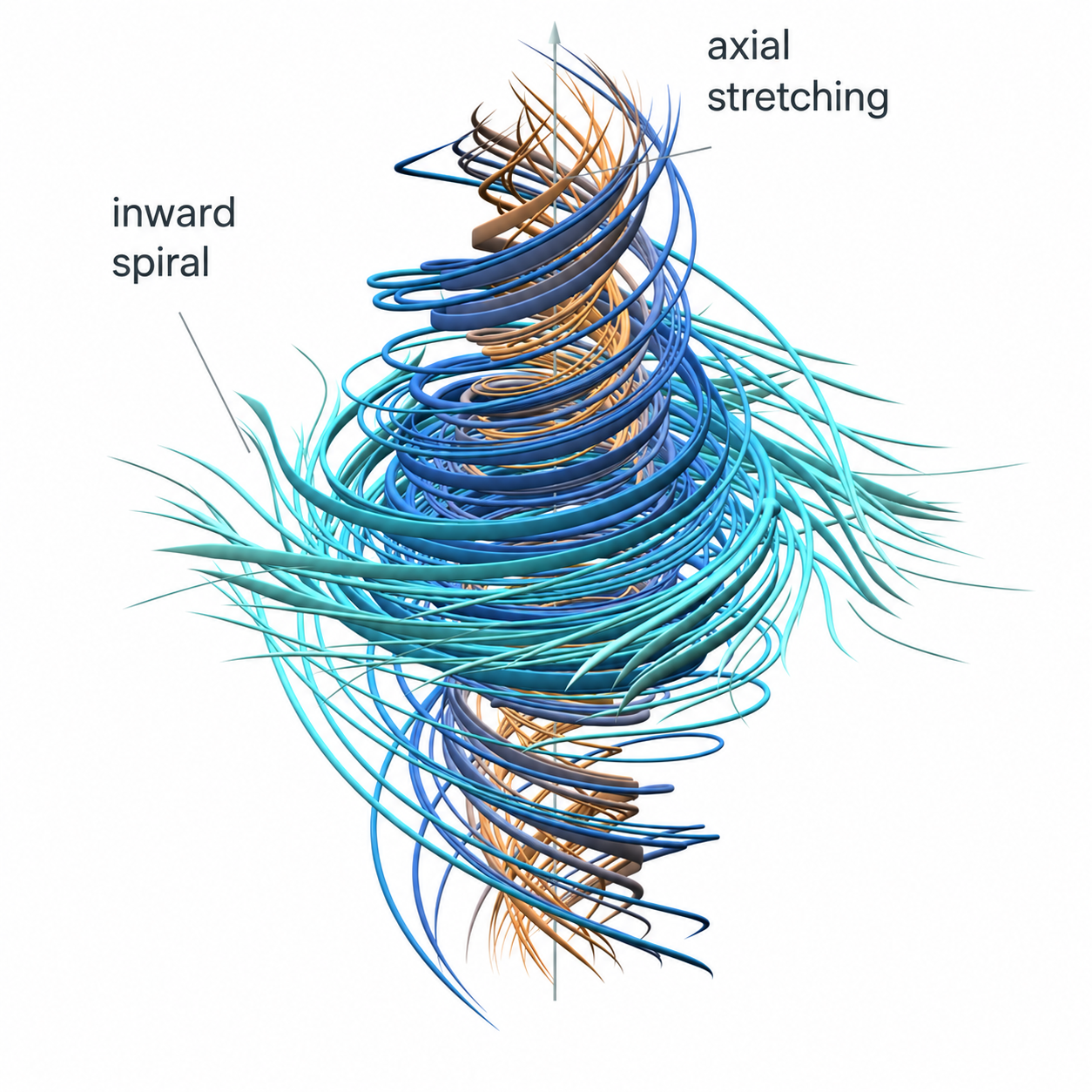
The proof, produced by an internal OpenAI model the company describes as significantly more capable than GPT-6 Astra, shows that an initially smooth three-dimensional fluid at rest, driven by a smooth external force and holding finite energy throughout, can develop a singularity in finite time. Fluid speed grows without bound as an elongating inward-spiraling vortex sharpens, with acceleration, pressure gradients, momentum transfer and viscosity growing large yet cancelling in a precise balance. The result establishes statements C and D in the official Millennium Prize formulation.
10,000 Coordinating Agents, 88 Hours
OpenAI said it launched the effort on September 1 after hearing rumors of pending Millennium resolutions, deploying agent groups against every open Millennium Prize problem. The Navier-Stokes group scaled to roughly 10,000 concurrent agents that arrived at the resolution on September 5, about 88 hours after launch. Lean formalization and verification via GPT-6 Astra took an additional 17 hours. Across all attempted problems the agents sent 4.9 million messages and consumed about 300 billion output tokens; Navier-Stokes alone accounted for 2.7 million messages and roughly 130 billion tokens. The system also produced an unforced Euler regularity disproof as a stepping stone.
Attribution Fight With Anthropic Researchers
OpenAI said the effort was inspired by rumors it later connected to Levent Alpöge at Anthropic and NYU math professor Tristan Buckmaster, whose concurrent work resolves the forced Euler equations rather than Navier-Stokes. OpenAI said it offered a joint announcement after finishing its Lean verification on September 6 and recognized their priority on the Euler problem, while stressing the proofs are different in method and scope. The company said it will not claim the $1 million Millennium Prize.
Why It Matters
The Navier-Stokes equations underpin aircraft design, weather forecasting and blood-flow modeling. A rigorous singularity result marks a formal breakdown of the continuum approximation, forcing new modeling choices where blowup can occur. It is also the highest-profile datapoint yet in a run of AI-assisted math advances, following Anthropic Claude's Fermat's Last Theorem formalization, Anthropic's 14.8 GW compute buildout and GPT-6 Astra's early robotics benchmarks.
Reporting based on coverage from OpenAI, CNN, Unite.AI and Fortune.