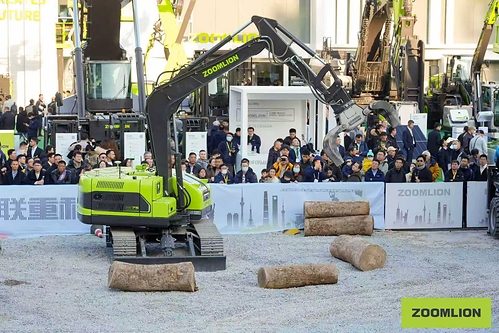
Zoomlion Heavy Industry used bauma CHINA 2026 in Shanghai on November 24 to show off what it calls the construction industry's first AI excavation robot powered by embodied intelligence. The machine pairs a wheeled humanoid upper body with a hydraulic excavator attachment, loading materials, building walls and aligning pipes with centimeter-level placement accuracy. It runs on 360-degree panoramic and 540-degree 3D vision, voice interaction and real-time visual feedback, letting it identify and position objects it has never seen arranged that way before, according to Zoomlion's announcement.
The robot sits inside a broader platform Zoomlion calls Zbrain, an industrial embodied-intelligence system meant to let skills learned on one machine transfer to another. The company says the pipeline draws on more than 5 petabytes of data gathered from upwards of 1.8 million connected machines operating across 170-plus countries, feeding roughly 10,000 industrial models. Alongside the excavation robot, Zoomlion showed its Z01 bipedal humanoid, which it says is headed toward mass production, and the Z03 wheeled humanoid, demonstrating millimeter-level precision sorting randomly arranged parts.
Construction is the harder test for embodied AI
Warehouses and factories have become the default proving ground for robot arms and humanoids: controlled lighting, known part geometries, flat floors, repeatable layouts. Construction sites offer almost none of that. Terrain shifts under load, dust obscures cameras and lidar, and raw materials rarely sit the same way twice from one job to the next. A robot that can place a pipe or stack a wall to centimeter accuracy outdoors, without a pre-scripted motion path, is a harder generalization problem than another warehouse-picking demo, and it targets a labor pool — skilled equipment operators — that is aging out faster than construction firms can replace it in most major markets.
That is also why the claim is notable even though it has not been verified by outside testing. Heavy-equipment makers including Caterpillar, Komatsu, XCMG and SANY have all pushed autonomy into excavators, haul trucks and loaders over the past few years, mostly through geofencing, path-following and remote operation rather than open-ended object manipulation. Zoomlion's pitch is different: a machine that reasons about an unfamiliar pile of material and decides, on the fly, how to pick it up and where to put it down, rather than following a mapped route.
The data moat, and its limits
Zoomlion's underlying argument is scale. Its 1.8-million-machine fleet, spanning cranes, concrete pumps and excavators sold worldwide, gives it a stream of operational data most humanoid startups simply do not have access to. That is the same logic Tesla applies to Optimus using its car fleet, and that AgiBot and Unitree are chasing through factory and logistics deployments in China. Equipment makers with machines already in the field have a structural edge over humanoid-only startups building expensive hardware with comparatively little real-world usage data to train on.
The caveat is that none of Zoomlion's figures — the petabyte count, the model count, the centimeter-level accuracy — have been independently benchmarked, and bauma demos are built to impress distributors and press, not to survive scrutiny of failure rates on a live job site. Embodied intelligence has a long history of trade-show polish giving way to messier field performance once weather, lighting and inconsistent materials enter the picture. There is also a cost question: hydraulic excavator attachments bolted onto a humanoid torso add complexity and maintenance overhead that a standard excavator cab does not carry.
Still, the move fits a pattern among Chinese industrial conglomerates: use an enormous existing equipment base as a data pipeline into humanoid and semi-humanoid robotics, rather than starting from zero like venture-backed humanoid startups. If Zoomlion can get the Z01 into mass production and push the excavation robot past demo stage into actual job sites in 2027, it would mark one of the first serious attempts to bring embodied AI out of the warehouse and onto dirt.