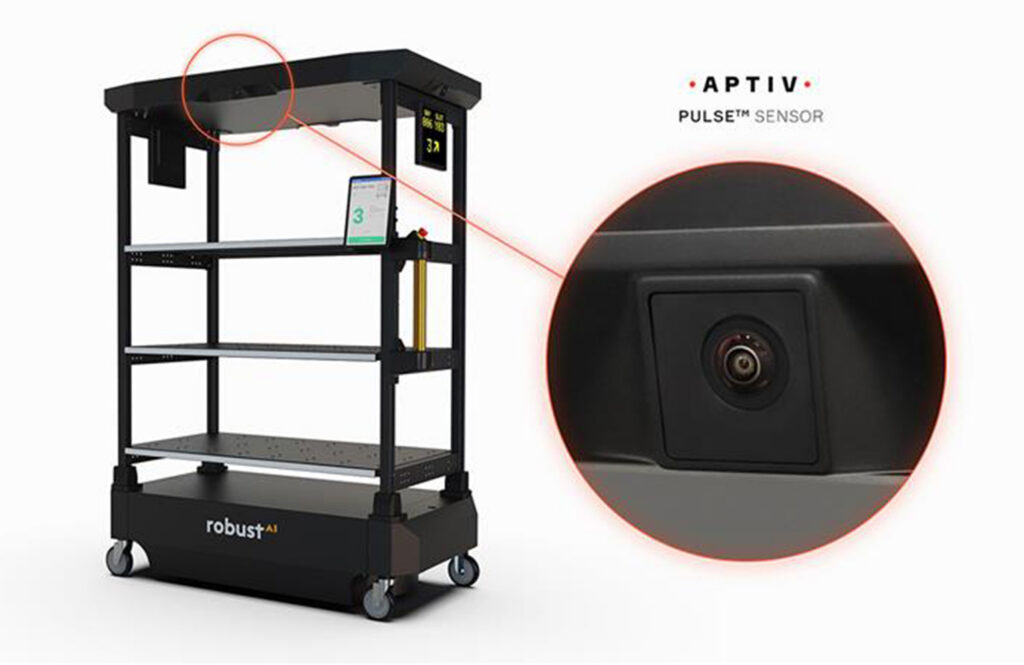
Robust.AI has selected Aptiv PLC's intelligent perception systems, powered by the Aptiv PULSE sensor, for its Gen 3 Carter collaborative mobile robot. The expanded partnership pairs Aptiv's automotive-grade camera-and-radar sensor fusion with Robust.AI's warehouse robotics to push toward functional-safety certification for physical AI.
Why perception is the bottleneck
Warehouses, manufacturing floors and cold-storage sites are dynamic environments full of dust, glare, moisture and reflective surfaces that can degrade conventional perception systems. By fusing radar and vision, Aptiv says it enables more reliable decision-making when robots operate around people and equipment. "Scale adoption of robotics requires safety-critical perception that spans the dynamic conditions experienced in the real world," said Jay Bellissimo, senior vice president of intelligent systems at Aptiv.

How PULSE works with Carter
PULSE combines a surround-view camera with ultra-short-range radar for 360-degree sensing while reducing blind spots, cost and complexity. Using machine-learning early fusion on raw sensor data, it supports depth-map creation and occupancy-grid population for navigation. Paired with Robust.AI's visual SLAM and AI perception, the system targets the complex conditions Carter is built for. The companies demonstrated the pairing at Automate 2026 in Chicago.
A path to safety certification
As part of the collaboration, Aptiv will obtain Performance Level d, or PL(d), certification for PULSE across relevant industrial safety use cases. PL(d), part of the ISO 13849-1 standard, is a high-reliability classification for hazardous robotics applications. "Carter is built to work with people in real warehouse and manufacturing environments, so perception quality, system reliability, and ease of deployment matter enormously," said Robust.AI co-founder and CEO Anthony Jules. The move reflects an industry-wide focus on certified safety, seen also in Sonair's safety-certified 3D ultrasonic sensor, advanced 3D vision systems at Automate 2026, and next-gen mobile manipulation platforms.
Reporting based on coverage from The Robot Report and Automated Warehouse.