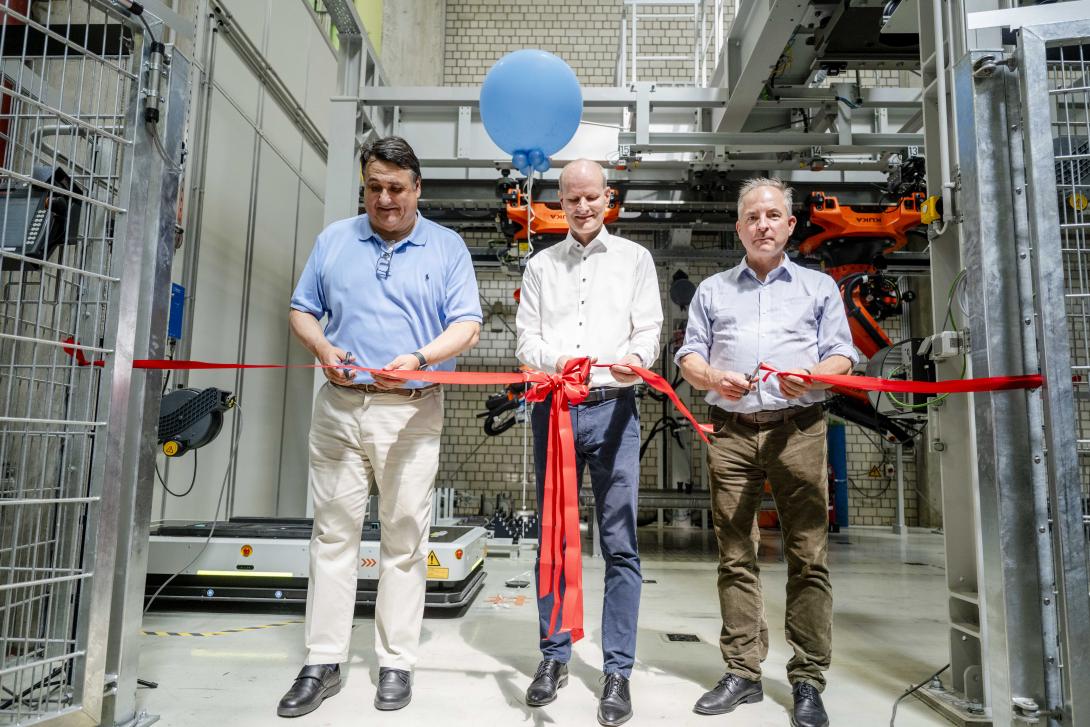
Ruhr University Bochum has switched on CREATE — a first-of-its-kind robotic concrete cell that produces a fully load-bearing precast structural panel in three hours. Three industrial robots choose from 13 interchangeable tools each, position adjustable formwork, weld or wire-tie reinforcement, pour concrete and shuttle the finished component into an oven for two-hour high-temperature curing. The system was formally opened on July 15, 2026 in the KIBKON test hall at Germany's Ruhr University Bochum (RUB).
From Manual Site Work To Waffle-Iron Precast
The gap CREATE is trying to close is enormous. On a traditional site or precast plant, formwork is assembled by hand from timber, reinforcement bars are laboriously tied with wire, and after concrete is poured it takes three to five days before formwork can be stripped and up to 28 days to reach full strength. "It is basically a waffle iron," said Professor Peter Mark, RUB's chair of structural engineering, describing the new digitally controlled workflow. "We wanted to draw inspiration from manufacturing methods in mechanical engineering for construction and put this theory into practice."
What Sits Inside The KIBKON Hall
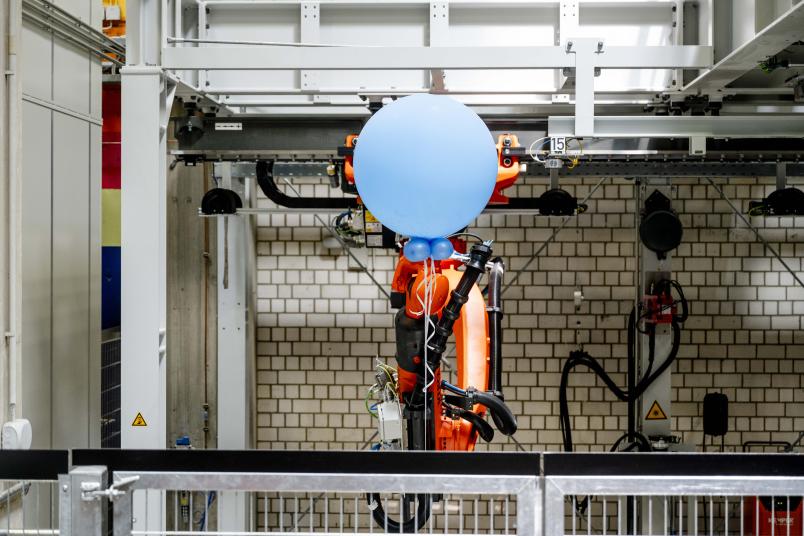
Each robot in the cell runs on a self-propelled industrial base and can grip, weld, or screw. All process steps are digitally logged, and staff can inspect any part of the build in real time through augmented-reality glasses. Curing takes place in an oven at 80 °C, cutting weeks of on-site set time to two hours.
The facility was funded by a German Research Foundation major-equipment grant that RUB won back in 2020. Precast specialist BT Innovation supplied and integrated the formwork subsystems.
Why It Matters For Construction Labour Shortages
Construction labour is scarce and expensive across Europe and North America. Digital cells like CREATE can operate day and night, produce standardised components repeatable to sub-millimetre tolerances, and — importantly for a labour-intensive sector — decouple output from the availability of skilled workers. RUB says the facility will be used within Collaborative Research Center 1683 "Modular Reuse," where it will study processes for disassembling and reprocessing precast concrete for reuse rather than demolition.
Where CREATE Sits In The Wider Construction Robotics Push
CREATE arrives against a busy backdrop for construction automation. See our recent coverage on Monumental's $32M Series B for bricklaying robots and Buildroid AI's model-based bricklaying platform. The global construction robotics market is on track to reach $3.5 billion by 2030, with material-handling and precast automation forecast to lead deployments.
Reporting based on coverage from Ruhr University Bochum News and Ruhr-Universität Bochum's official press office.