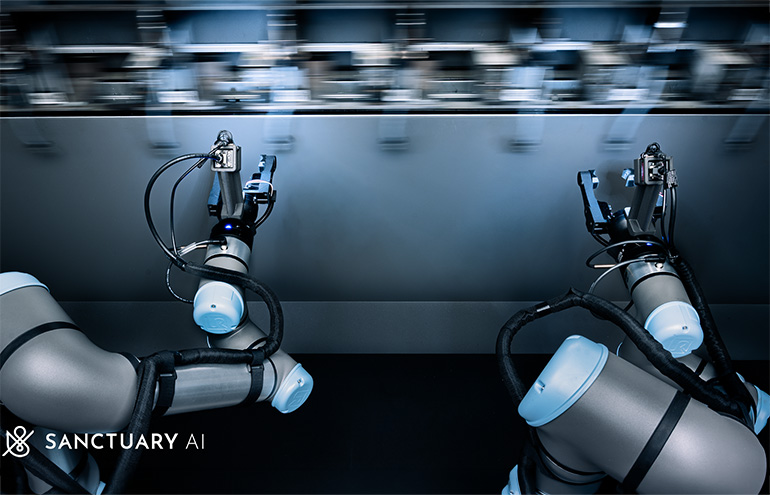
Sanctuary AI says it has achieved "world-class performance" on a complex manufacturing task, deploying its physical AI on an existing industrial robot at a global Tier 1 automotive supplier. Announced on June 17, 2026, the result is a proof point for a strategy shift: rather than wait for humanoid hardware to mature, the Vancouver company is putting its intelligence to work on the factory floor today.
Production-line numbers
The system hit a 99.5%+ task success rate at a 2.54-second cycle time on a wire-plugging task, validated against the customer's live production benchmarks. The job required manipulating a flexible wire into a moving target on a conveyor - a contact-rich dexterity problem that traditional automation has struggled to handle reliably. "That's the bar physical AI has to clear to matter in enterprise environments, and it's the bar we've now cleared," said co-founder and CTO Olivia Norton.
Hardware-agnostic by design
Sanctuary AI built its reputation on the Phoenix general-purpose humanoid and its Carbon control system, but the company now emphasizes a multi-embodiment approach that runs its models across diverse hardware, mobility options and end effectors - with a path to humanoids. Its IP portfolio and proprietary high-degree-of-freedom hydraulic hands underpin the dexterity work, and it demonstrated zero-shot in-hand manipulation earlier in 2026.

Riding the dexterity wave
The milestone arrives during a busy stretch for robotic manipulation and humanoids, from RLWRLD and NVIDIA's DexBench dexterity benchmark to Foxconn's European humanoid debut and NVIDIA's Unitree research platform. Sanctuary argues that a performance-first model deployed on commercial robots gives manufacturers value now while laying the foundation for tomorrow's general-purpose systems.
Reporting based on coverage from The Robot Report and Sanctuary AI.