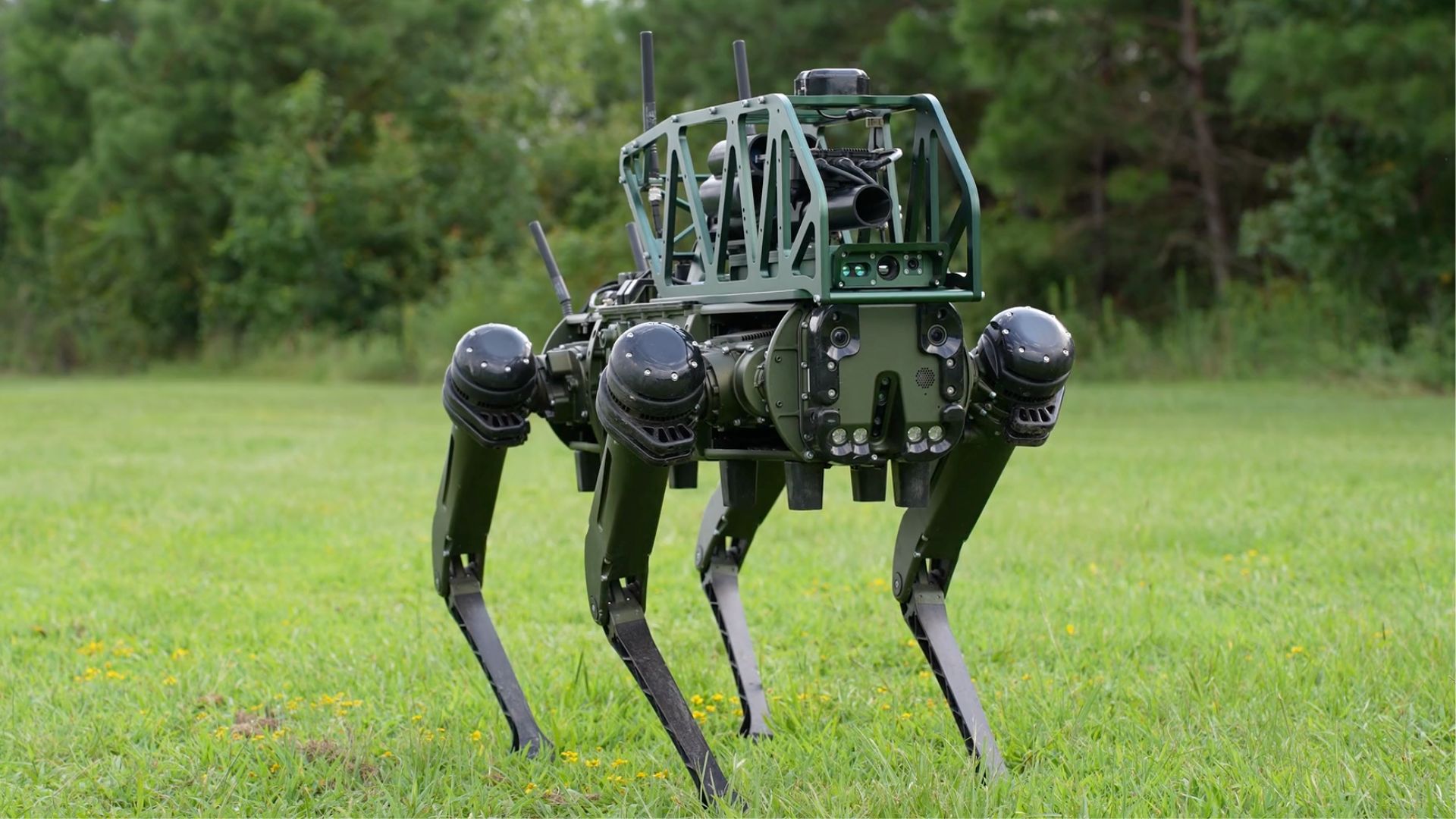
The U.S. military has cleared one of its most provocative robotic weapons programs for field trials. Skyborne Technologies, a U.S. and Australian defense technology company, has achieved a U.S. Department of War (DoW) Limited Safety Release for its CODiAQ (Controller Operated Direct Action Quadruped) armed unmanned ground system, authorizing the four-legged robot to move from development into Operational Test & Evaluation (OT&E) and combat evaluations.
A $6.5 million contract for armed robot dogs
The clearance is tied to a competitively awarded US$6.5 million firm-fixed-price research, development, test and evaluation (RDT&E) contract. Under the deal, Skyborne will deliver 14 quadruped robotic systems and 28 modular weapon payloads, along with 24 months of total system sustainment covering hardware support, maintenance and repair to keep the platforms mission-ready throughout evaluation. The award also funds operator and maintainer training so U.S. and allied personnel can safely employ and assess the systems in the field.
Delivery is scheduled as a single coordinated fielding event this year, supporting evaluations requested by multiple tactical units within U.S. Special Operations Command (USSOCOM) and a partnered foreign ally. The effort echoes a wider Pentagon push toward ground autonomy seen in programs such as the Pentagon's $500 million counter-drone deal with Perennial Autonomy.
Independent safety testing at Aberdeen
Independent government safety testing was conducted by the U.S. Army Test and Evaluation Center (ATEC) at Aberdeen Proving Ground, Maryland, validating key system safety requirements against established department standards before any live-armed autonomous system enters field evaluation. "This milestone allows the Department of War to rapidly assess operational utility with rigorous emphasis on system safety, operator control, and risk management during OT&E and combat evaluations," said Michael J. Trexler, the government program manager, who added that the team is working to deliver CODiAQ and live-fire training to tactical operators in October 2026.
How CODiAQ works
CODiAQ pairs its lethal payloads with the Ghost Robotics Vision 60 quadruped platform. The modular weapon options include Skyborne's HAVOC 40mm and CHAOS 12-gauge systems, mated to an onboard Targeting Electronics Optical Box (TEOB) that handles real-time target detection, day and night operation, and ballistic calculation. Skyborne's EXITUS AI targeting software keeps a human in the loop, with controlled, supervised engagement. A single operator drives the system through a handheld controller while the robot manages its own movement across rubble, forest and urban terrain such as stairs; it is rated IP67 for dust and water resistance and can be mission-ready within minutes. The platform builds on a broader trend of armed quadruped military robots entering frontline service.
A sovereign manufacturing push
Skyborne says the CODiAQ units are manufactured in the United States, an early step in scaling domestic production aligned with department guidance on secure supply chains and long-term sustainment. The company showcased CODiAQ at SOF Week in Tampa, Florida, from May 19 to 21, 2026. The award extends a run of robotics deliveries to allied militaries, including L3Harris's recent handover of T4 and T7 tactical robots to the Australian Defense Force.
Reporting based on coverage from GlobeNewswire (Skyborne Technologies) and Interesting Engineering.