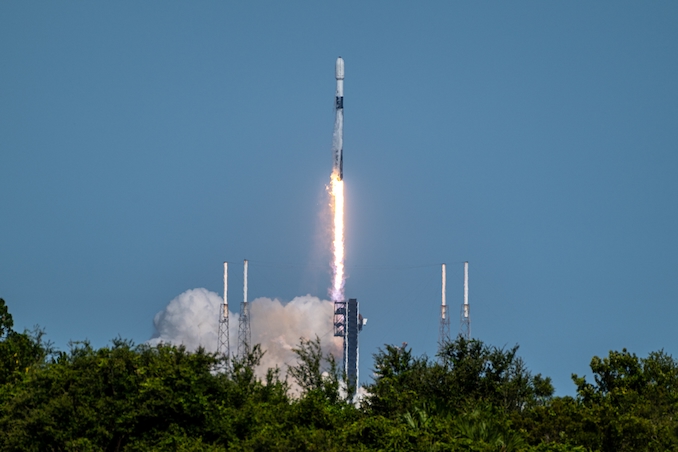
A SpaceX Falcon 9 rocket lifted off from Cape Canaveral on July 21 carrying Northrop Grumman's Mission Robotic Vehicle (MRV) and three Mission Extension Pods (MEPs), starting a decade-long campaign to inspect, repair and extend the life of satellites already parked in geosynchronous orbit.
Robot arms bolted to a satellite bus
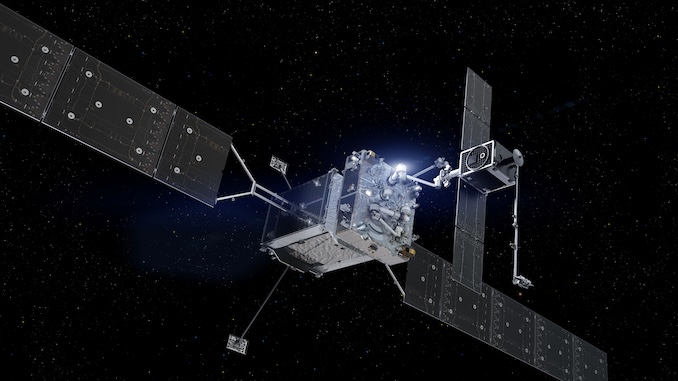
The MRV is the free-flying platform. Bolted to its side is the U.S. Naval Research Laboratory's Robotic Servicing of Geosynchronous Satellites (RSGS) payload, a pair of dexterous robotic arms with a suite of interchangeable tools developed with DARPA funding. The arms are designed to grapple client spacecraft at their launch-vehicle interface ring, a sturdy structural feature almost every commercial satellite shares, avoiding damage to delicate instruments.
Eight extra years, three customers at a time
The MRV and MEPs will spend roughly a year climbing to geosynchronous Earth orbit before servicing begins. Each MEP carries fresh maneuvering fuel and jetpacks onto a client satellite, delivering up to eight additional years of station-keeping. Australia-based Optus and Luxembourg-based SES are lined up as the first customers.
Decades from concept to launch
RSGS traces its lineage to early-2000s NRL studies of two uncrewed spacecraft performing autonomous rendezvous and docking, followed by DARPA's SUMO and FREND programs. Northrop Grumman's SpaceLogistics unit was tapped in 2019 to combine RSGS with the MRV bus. After on-orbit checkout, the payload will be handed to the U.S. Space Force's Servicing, Mobility and Logistics portfolio.
Booster B1069 flew the mission on its 32nd and final flight, expended because of the extra performance required to send the payload to geosynchronous transfer orbit. The launch also caps a busy stretch for the company as it prepares its Starship Flight 13 attempt.
Why on-orbit servicing matters now
Commercial GEO operators are running out of fuel on billion-dollar assets faster than they can afford to replace them, and the U.S. military wants persistent inspection and repositioning options for its own high-value spacecraft. Success here would move satellite servicing from one-off demonstrations to a recurring commercial service, a shift that has been talked about for two decades but has never been operational at scale.
Reporting based on coverage from Spaceflight Now, Northrop Grumman, DARPA and the U.S. Naval Research Laboratory.