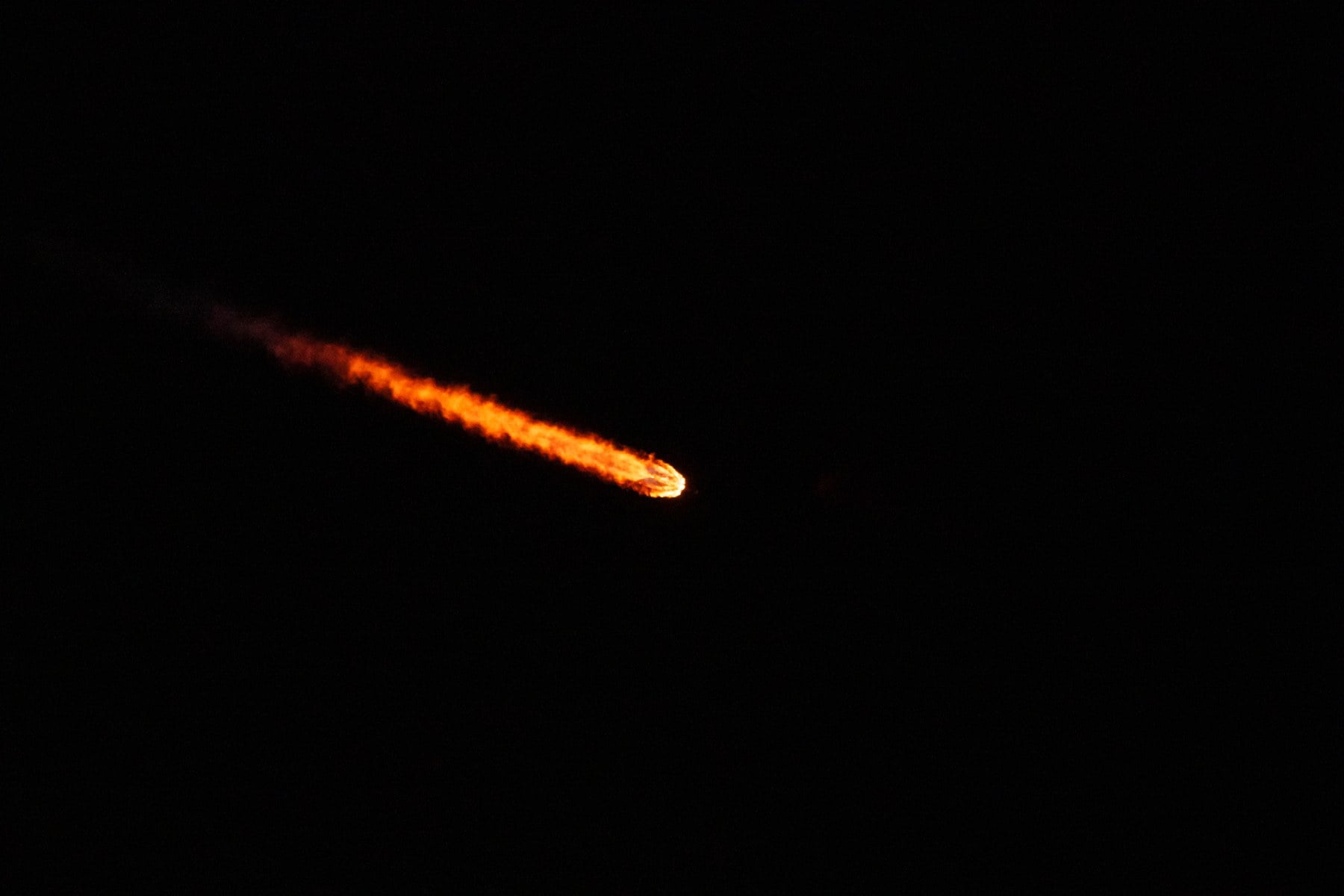
SpaceX has crossed another orbital milestone that reshapes what "the space environment" actually means. At 04:01 UTC on August 19, 2026, a Falcon 9 lifted off from Vandenberg Space Force Base with 24 more Starlink spacecraft, and about an hour later the deployment appears to have pushed the constellation past 11,000 satellites in orbit — with a single commercial network now representing roughly two-thirds of every active satellite circling Earth.
How The 11,000 Threshold Was Reached
The mission, Starlink Group 17-50, flew from Space Launch Complex 4 East and was SpaceX's 100th launch of 2026, its 97th Falcon 9 flight of the year. Booster B1097 completed its 12th flight and landed on drone ship Of Course I Still Love You. Working from independent orbital tracker Jonathan McDowell's public count of 10,939 Starlinks before the August 11 Starlink 10-19 mission, three subsequent launches added 29, 24 and another 24 satellites — a straight sum of 11,016 in orbit, with the true live number varying by a handful as older Starlinks reenter and new ones raise to their operational planes.
Two-Thirds Of Active Satellites Now Fly One Logo
The concentration comparison comes from Look Up Space's Q2 2026 index, which counted 15,711 active satellites worldwide, of which 10,365 were Starlinks — 65.97 percent. Both sides of that ratio have grown since June as China's constellations, Amazon's Leo network and other operators launch new spacecraft, but the honest scale description remains "roughly two-thirds." At the start of 2019, fewer than 2,000 active satellites orbited Earth in total; Starlink alone is now more than five times that entire earlier population.
What Actually Counts As "In Orbit"
The nuance matters. Newly launched Starlinks sit briefly in a low deployment orbit, undergo checkout and then use their onboard thrusters to climb to assigned planes; retired satellites descend for months toward atmospheric reentry. McDowell's phase-plane statistics only count spacecraft that are already in operational orbit, which is why some reports still say "nearly 11,000 operational satellites" even after the physical in-orbit count crosses 11,000. Launched, deployed, in orbit, active and operational orbit are not interchangeable labels.
Why It Matters For Everyone Else
The scale is what makes low-latency broadband work for ships, aircraft, rural users and disaster zones — but it also raises the coordination workload for every other operator. Conjunction screening, maneuver planning and safe end-of-life disposal now revolve around one fleet's cadence. In 2026, 74 of SpaceX's first 100 missions have been Starlink flights, and the constellation is continuously refreshed rather than merely growing. Related coverage: SpaceX's 100th mission of 2026, Starlink 17-50 details and SpaceX's August lunar impact story.
Reporting based on coverage from SpaceDaily, Space.com and Jonathan McDowell's Starlink statistics.