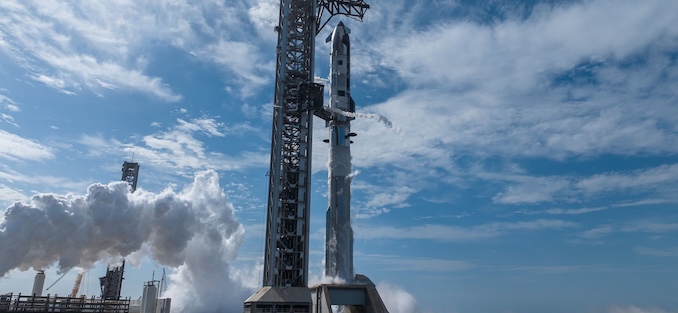
SpaceX moved to launch the third generation of its Starship rocket from Starbase, its company town in southern Texas, in a closely watched test that marks the debut of the most powerful version of the vehicle yet. The 407-foot-tall (124-meter) two-stage rocket flew on a suborbital mission designated Flight 12, after the company scrubbed its first launch attempt earlier in the week.
What Flight 12 aims to prove
For this twelfth integrated test flight, the Super Heavy booster, known as Booster 19, was set to splash down in the Gulf of Mexico about seven minutes after liftoff rather than return for a tower catch, because the upgraded vehicle is still early in its testing campaign. The Starship upper stage, Ship 39, targeted a controlled splashdown in the Indian Ocean more than an hour after launch. The launch window opened at 5:30 p.m. PDT.
A heat-shield and Starlink test
SpaceX planned to deploy 20 Starlink simulator satellites on a suborbital trajectory over roughly 10 minutes, beginning about 17 minutes into the flight. Two additional "modified Starlinks" were to be released to scan Starship's heat shield and transmit imagery back to operators, helping engineers analyze the shield's readiness for future return-to-launch-site missions. Several tiles were painted white to simulate missing tiles and serve as imaging targets. The company also planned to relight one of Ship 39's Raptor engines during a coast phase to inform future deorbit burns.
Billions invested in reusability
In a filing with the U.S. Securities and Exchange Commission, SpaceX said it has invested more than $15 billion in Starship development, including roughly $3 billion in research and development expense in 2025 alone. The company expects Version 3 to eventually carry 100 metric tons or more of payload to orbit. The push toward fully reusable heavy-lift launch parallels broader advances in autonomous flight and space hardware, including funding for autonomous aircraft systems and robotic arms tested for in-orbit servicing.
What comes next
SpaceX has said that if Flight 12 goes well, Flight 13 could be an orbital launch, though that has not been confirmed. The progress comes as the broader Elon Musk technology empire scales rapidly, including ventures such as a large AI chip manufacturing project. Two earlier explosive setbacks on the test stand had destroyed a Super Heavy booster and a Starship during development, underscoring how iterative the program remains.
Reporting based on coverage from Spaceflight Now and Space.com.