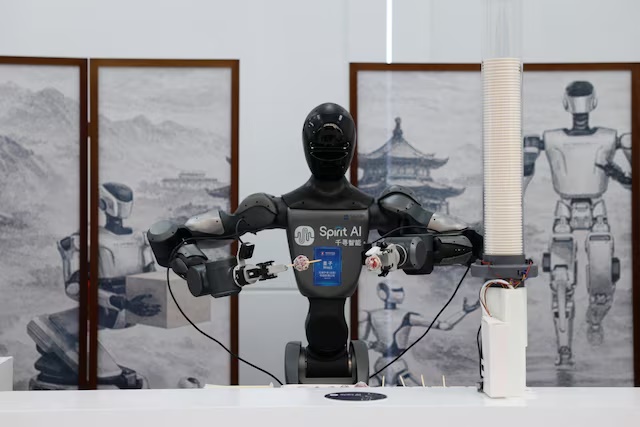
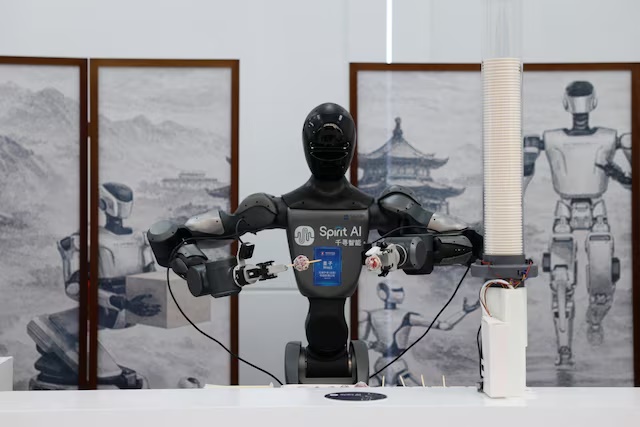
Chinese embodied-AI startup Spirit AI expects humanoid robot brains to reach a "GPT-3 moment" — where a natural-language instruction reliably translates into a sequence of coherent physical actions — by the middle of 2027, co-founder and chief scientist Gao Yang told Reuters in a briefing published on September 18. Gao, an assistant professor of robotics at Tsinghua University, said the brain is now the weakest link in the humanoid stack, not the hardware.
What Spirit AI Is Doing Differently
The Hangzhou-based company, founded in 2024 and valued at roughly 20 billion yuan (~$2.9 billion), has raised more than $670 million to date, including the 1.5 billion yuan Series A+ we covered earlier. Its data strategy leans on a proprietary "dirty data" pipeline — wearable data-collection devices worn by workers — that Spirit says cuts data-generation costs by 90%. It has amassed more than 200,000 hours of interaction data, targeting 1 million hours by year-end.
Its Moz1 wheeled humanoid is already deployed in the tens on production lines at battery giant CATL and JD.com fulfillment centers, with additional partnerships across Huawei, Xiaomi and TCL. The company employs about 300 people directly plus roughly 1,000 contractors dedicated to data collection.
Why 2027 Matters
A GPT-3 moment in embodied AI is the point at which a robot no longer needs task-specific programming for every new environment. Spirit AI thinks that shift will trigger a Cambrian explosion of humanoid applications in factories, warehouses and eventually consumer settings. It also reframes the competition: JD.com and CATL are effectively co-training partners, not customers, and Chinese companies with real deployment data may leapfrog Western labs still doing simulation-heavy pretraining. Spirit's Spirit v1.6 model already topped the North American RoboArena leaderboard earlier this year.
The Race Around Physical AI
Gao's timing echoes an accelerating deployment race across China. This week alone, Shutu raised nearly RMB 100M pre-Series A for tactile data, and D-Robotics closed a $400M Series C to scale Sunrise chips for humanoids. If Spirit AI is right and a GPT-3 moment arrives in 2027, expect the winners to be the companies that can pair a scalable foundation model with real production-floor data — a game that Western labs, without CATL-scale factories, will find hard to match.
What To Watch
Two things: whether Spirit v1.7 or v2 lands ahead of its GPT-3 target date, and how many Moz1 units CATL and JD.com actually order. Spirit's own commercial credibility hangs on whether tens of humanoids on production lines become hundreds by mid-2027.
Reporting based on coverage from Reuters, The Standard (Hong Kong), and Humanoid Index.