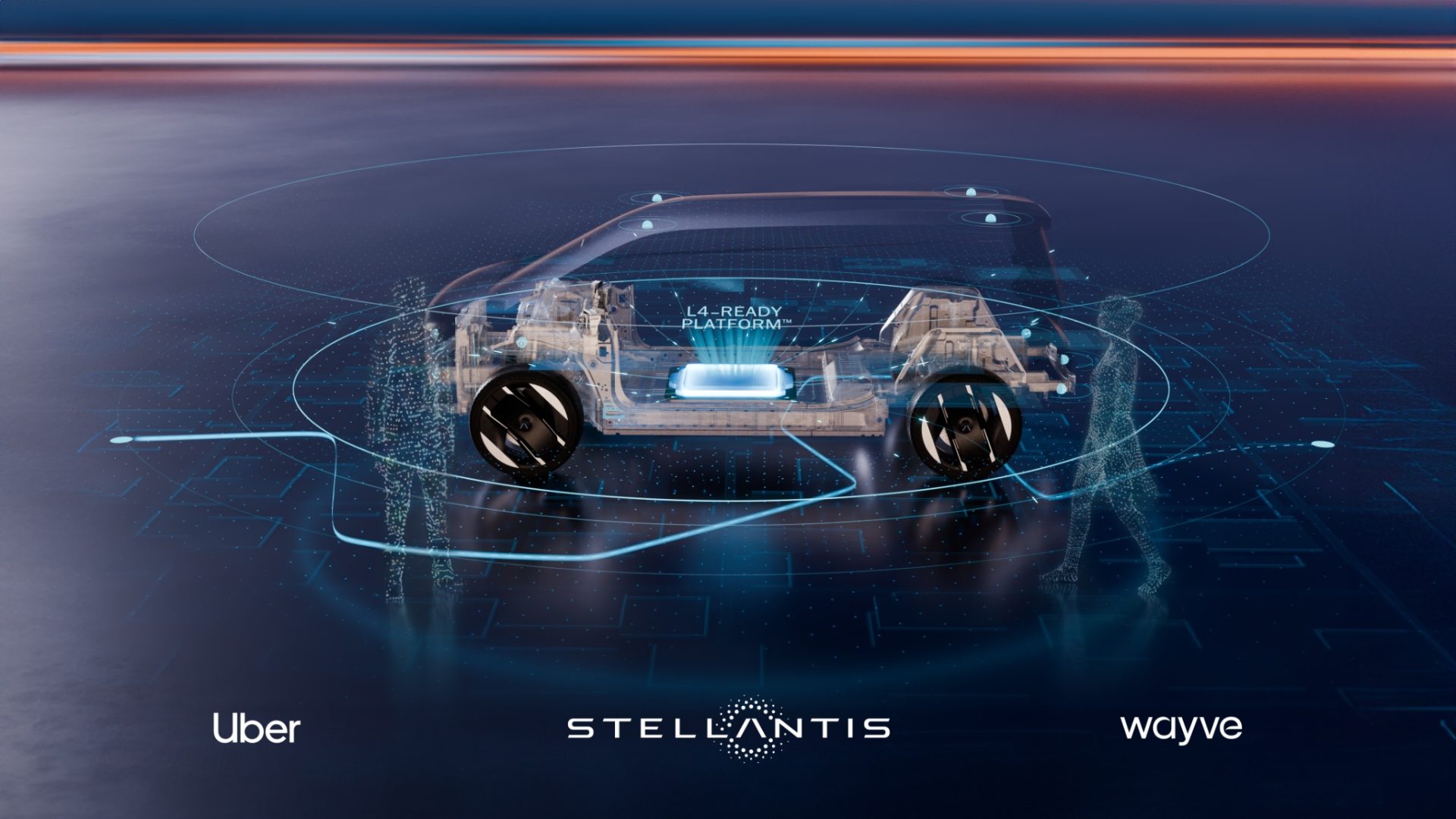
Stellantis, Wayve and Uber announced on June 17, 2026, that they have entered a partnership to jointly explore the development and deployment of Level 4 (driverless) robotaxis at a global scale. The collaboration combines Stellantis' L4-Ready Platforms, Wayve's AI driving technology and Uber's global marketplace into a single ecosystem aimed at commercializing autonomy faster than any one company could alone.
Three Complementary Strengths
Under the non-binding Memorandum of Understanding, Stellantis will design, engineer and manufacture vehicles built on advanced L4-Ready Platforms with embedded sensor suites and the redundancy required for high-utilization driverless operations. Wayve will provide the AI driving software, built on its end-to-end embodied-AI approach that adapts across regions and conditions without city-by-city mapping. Uber will deploy the vehicles on its global mobility network, connecting riders to autonomous trips through the Uber app.

Building On Existing Ties
The three-way deal builds on a web of existing relationships: Stellantis and Wayve's recent L2++ agreement to integrate the Wayve AI Driver into the STLA AutoDrive platform, and Wayve and Uber's partnership to deploy autonomous rides in London, Tokyo and ten other cities. It also follows Stellantis' separate Level 4 robotaxi pilot in Luxembourg with Bolt and Pony.ai, underscoring the automaker's multi-partner approach to autonomy.
An Ecosystem Bet
"This is just another strong signal that the industry is converging around Wayve's technology as the way to scale AVs globally," said Kaity Fischer, Wayve's VP of Commercial and Operations. Stellantis CTO Ned Curic framed the L4-Ready Platforms as "designed from the ground up for safe and efficient driverless operation." The companies plan to work together on vehicle integration, testing, validation and deployment across Europe, North America and beyond — a contrast to vertically integrated rivals such as Mobileye's own planned robotaxi service.
What Comes Next
The MoU establishes a framework for future agreements covering technology development, licensing, production and vehicle procurement, with each company retaining flexibility to pursue additional collaborations. It represents a significant step toward commercial robotaxi services at scale and reinforces a growing consensus that the most efficient path to autonomous mobility runs through a powerful ecosystem rather than a single vendor.
Reporting based on coverage from Wayve, Stellantis and Automotive News.