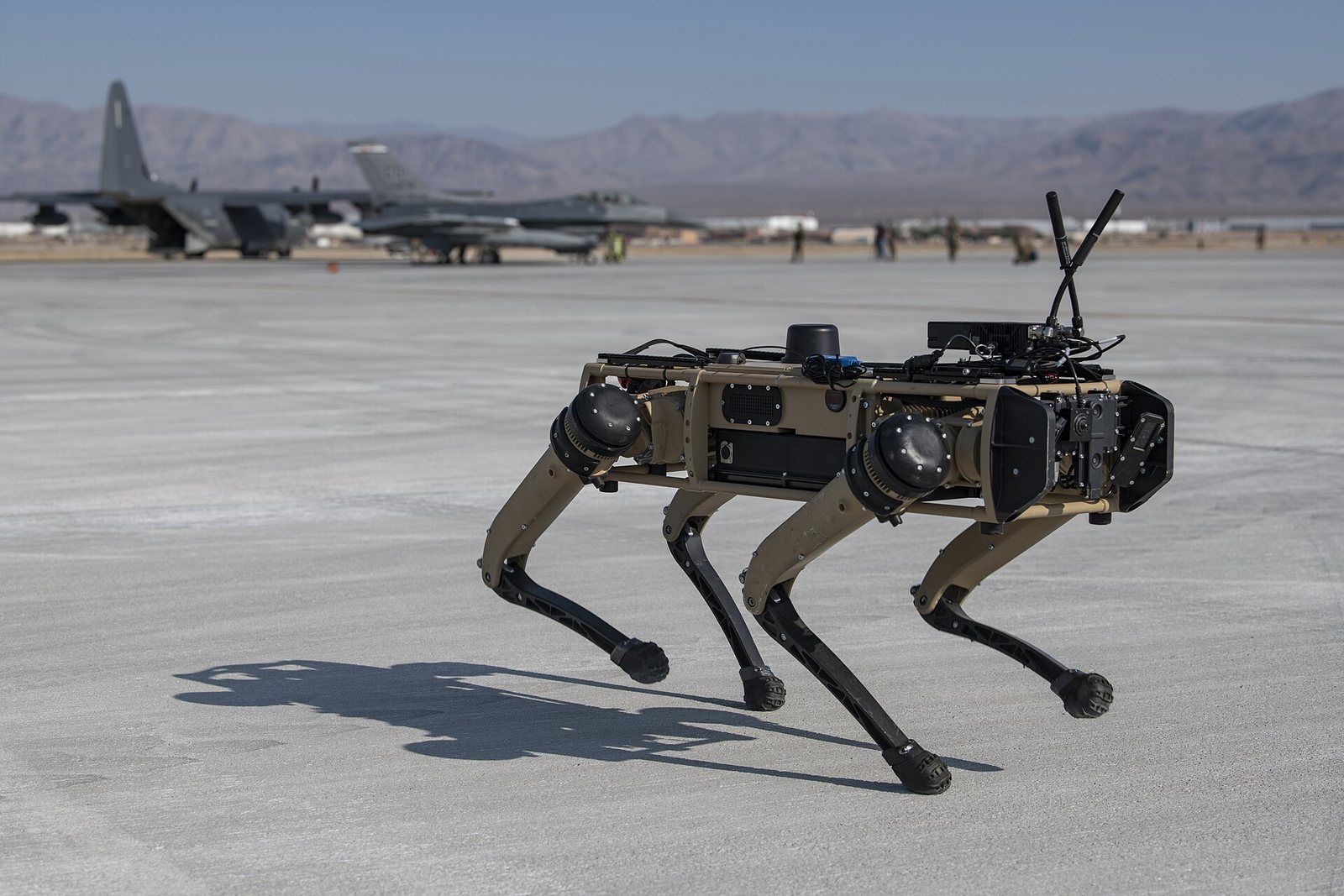
Taiwan's Ministry of National Defense is budgeting NT$178.6 million (roughly $5.7 million) over the next five years, from 2027 to 2031, to test whether robotic "dogs" can patrol military bases and track drones, according to Seoulz. The money is split across all three branches: NT$49.99 million for the army, NT$40.2 million for the navy and NT$88.4 million for the air force, which is taking the largest share because the trial also covers counter-drone duties.
The plan leans on hardware already built. Taiwan's National Chung-Shan Institute of Science and Technology, the island's main state-run defense lab known as NCSIST, has been fitting the four-legged Vision 60 robot made by US company Ghost Robotics with homegrown sensors and weapons. Three variants are in the works: one carries electro-optical cameras for reconnaissance, one adds a remote weapon station for direct combat support, and one swaps in LiDAR and thermal imaging for mapping and night surveillance. A fourth, anti-drone configuration is also in development, pairing small radar with electronic-warfare jamming gear NCSIST already builds for other programs.
What can these robot dogs actually do?
The Vision 60 platform itself weighs about 52.4 kilograms, can carry a payload of up to 10 kilograms, and moves at roughly 2.5 meters per second — a brisk walking pace, not a sprint. Battery life runs eight to ten hours per charge, long enough for an overnight perimeter check. That is the baseline chassis; NCSIST's job is bolting on the cameras, radios and weapons that turn a generic walking robot into something a base commander could actually use for rounds that would otherwise require a soldier with a flashlight.
Robots like this are not meant to replace human guards outright. Instead, they are built to cover repetitive, exhausting work — walking the same fence line every few hours, every night, in all weather — freeing soldiers for tasks that need judgment calls. The counter-drone variant matters most right now: small, cheap quadcopters have become one of the easiest ways to scout or strike a fixed base, and a slow-moving human patrol often spots them too late.
Why is this happening now?
Ghost Robotics is no longer a purely American company. In July 2026, South Korean defense firm LIG D&A — formerly known as LIG Nex1 — bought a 60% stake in Ghost Robotics for about $249 million, giving a close US ally direct control over the platform's production and roadmap. That deal, combined with NCSIST's existing counter-drone electronics, makes Taiwan's trial less of a leap than it might look: the island is essentially marrying a proven American-designed robot body to sensors and weapons it was already developing in-house.
Taiwan is also not alone in testing armed or sensor-laden quadrupeds. Chinese makers Unitree and Deep Robotics have both shown off military-adjacent robot dogs, and similar machine-gun-equipped units have turned up guarding sites as far away as Haiti this year. For Taipei, which faces a much larger neighbor across the strait, giving a handful of bases automated eyes that never blink is a relatively cheap way to buy some reassurance while the broader robot-dog arms race plays out.
What happens next?
Taiwan Review News, cited by Seoulz, cautions that the "overall robot-dog patrol trial remains under review and planning," and that detailed configurations will only be disclosed once the plan is confirmed. That means the budget figures are a starting point, not a signed contract — NCSIST still has to prove each variant works reliably before the army, navy and air force commit to buying in volume. If the trial holds to its five-year schedule, the first production decisions would land sometime around 2029 or 2030, giving Taiwan time to watch how similar programs elsewhere shake out first.