
Teledyne Technologies subsidiary Teledyne FLIR Defense has been awarded an $11.2 million U.S. Army contract to deliver more than 45 autonomous unmanned aircraft kits that can detect chemical, biological, radiological and nuclear hazards without sending soldiers into the contaminated zone. The contract was announced on June 4, 2026 by the Army's Capability Program Executive for Chemical, Biological, Radiological and Nuclear Defense (CPE CBRND).
SkyRaider gets a CBRN brain
At the heart of each kit is Teledyne FLIR's R80D SkyRaider quadcopter UAS, reconfigured with semi-autonomous CBRN search and survey capabilities developed under the Army's Chemical, Biological, Radiological and Nuclear Sensor Integration on Robotic Platforms (CSIRP) program. CSIRP is the service's effort to rapidly prototype and field modular sensor packs that bolt onto drones and unmanned ground vehicles, layering AI, machine learning, autonomy and resilient communications on top of legacy detection chemistry.
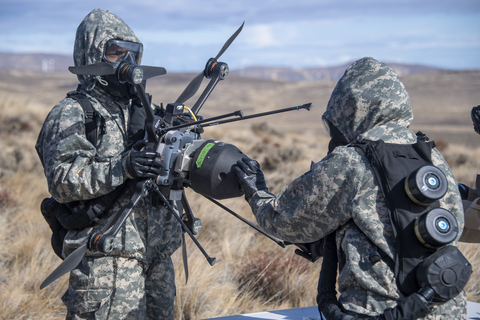
Each kit carries a suite of chemical, biological and radiological detection payloads, including Teledyne FLIR's MUVE B330 biological sensor. Once airborne, the SkyRaider can autonomously locate and characterize CBRN threats and stream real-time hazard data into the operator's mapping, targeting and communications tools.
Keeping the warfighter out of the plume
"Safeguarding soldiers from weapons of mass destruction is at the core of our mission," said Dr. JihFen Lei, president of Teledyne Defense and Aerospace Group and a senior vice president of Teledyne Technologies, in the announcement. "These SkyRaider-based sensor kits dramatically improve how units can detect and map CBRN hazards without exposing warfighters to dangerous environments."
The contract also builds on Teledyne FLIR Defense's role as lead integrator for the Army's NBCRV Sensor Suite Upgrade program, which is modernizing the sensor stack on the service's Nuclear, Biological and Chemical Reconnaissance Vehicle Stryker platform. The new SkyRaider kits are being designed to talk to that same NBCRV command-and-control interface, so a Stryker crew can flow data from a flying scout straight into its on-board picture.
Production already lined up
The kits are being built at Teledyne FLIR Defense facilities in Elkridge, Maryland and West Lafayette, Indiana, with engineering support out of Stillwater, Oklahoma. Deliveries are expected to begin in the second quarter of 2026, an aggressive schedule that mirrors the Army's broader push to field drone-borne sensors quickly under operational pressure.
The award lands in the same week the Army committed $117.3 million to AeroVironment's P550 reconnaissance drone, underscoring how aggressively the service is pulling autonomy into every layer of its tactical formation. Earlier programs from Saildrone and Boeing's MQ-25A have set the template for unmanned platforms moving from prototype to production under tight timelines.
Reporting based on coverage from Teledyne Technologies via BusinessWire and Stock Titan.