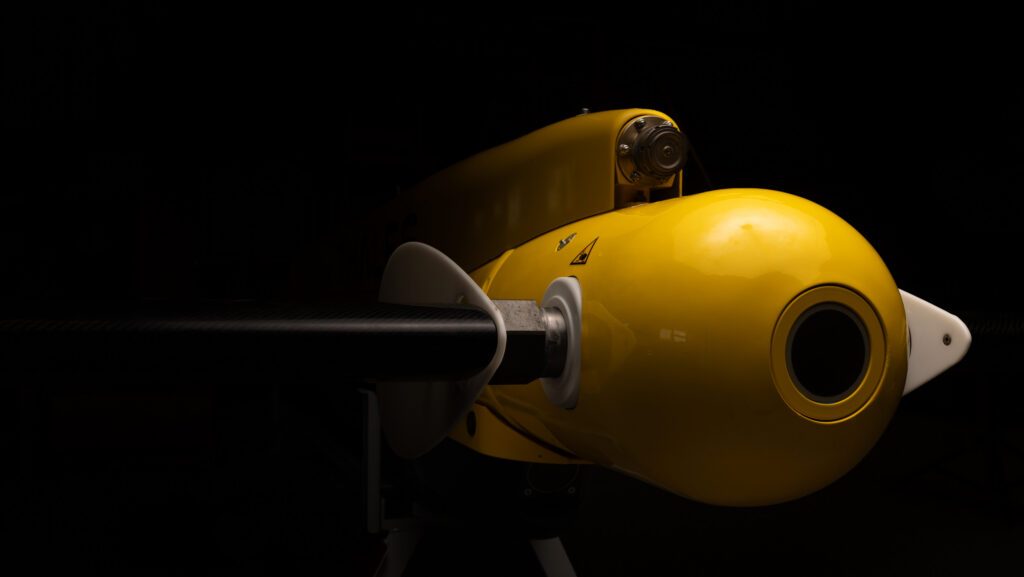
Advanced Acoustic Concepts, a U.S. subsidiary of French defense group Thales, has won a $53.9 million U.S. Navy contract to build two Remote Mine Hunting modules and provide engineering support, according to Breaking Defense, which confirmed the award on November 3, 2026. The deal carries options that could push its cumulative value to roughly $196.2 million if the Navy orders additional modules, with the first two systems due for delivery by October 2029 and follow-on units potentially delivered through 2039.
The RMH modules pair Thales' SAMDIS 600 sonar with AI-assisted target-recognition software and remotely operated vehicle hardware, giving the Navy a single package to find, classify and ultimately clear sea mines without sending a crewed ship or divers over a minefield. The sonar's three-beam design captures an object from multiple angles in a single sweep, which a Thales executive described as sharply raising confidence that something flagged on sonar is actually a mine rather than rock or debris.
Why the Navy Is Paying for Robotic Mine Hunting Now
The contract lands against a backdrop of renewed mine-countermeasures activity. The Navy has leaned on unmanned systems since April 2026 under Operation Epic Fury, its response to mine threats in the Strait of Hormuz, and that operational tempo has sharpened the service's appetite for mine-hunting hardware that does not require divers or minesweepers to work close to a live threat. Removing sailors from that risk is the central selling point: mine warfare has historically produced some of the Navy's most dangerous and labor-intensive missions, and autonomous or remote-controlled systems let a crew stand off at a safer distance while software does the searching.
The program also reflects a shift toward networked, modular mine-hunting kits rather than single-purpose ships. Thales has paired SAMDIS 600 with HII's REMUS 620 unmanned underwater vehicle in a recent demonstration that combined autonomous search with Thales' ANGLER effector for mine neutralization, suggesting the Navy is building toward a chain of unmanned systems that search, classify and neutralize in sequence rather than relying on one vessel to do all three.
A Narrow but Entrenched Competitive Field
Few companies build mine-hunting sonar and effector systems at the scale the Navy requires, which limits competition mostly to established defense primes with existing undersea-warfare contracts. Thales and AAC's advantage is an incumbent position reinforced by years of integration work with the Navy's mine-countermeasures architecture, plus the SAMDIS sonar's track record on platforms including the REMUS family of underwater vehicles. That makes the RMH award less a contest won on price than a continuation of a relationship the Navy has already built out over several contract cycles.
The trade-off for the Navy is dependency: concentrating mine-hunting sonar, software and effectors with one supplier network simplifies integration but leaves fewer alternatives if Thales and AAC face production delays. With delivery windows stretching to 2039, the contract also locks in a sonar architecture for more than a decade, a long horizon in a field where AI-assisted target-recognition software is improving quickly enough that today's system could look dated well before the last module ships. Some competitors are pushing a cheaper, more distributed alternative instead of the Navy's single-vendor model: French manufacturer Seaber has marketed compact autonomous underwater vehicles priced at roughly a third of high-end mine-hunting platforms, betting navies will eventually favor many inexpensive drones over a smaller number of expensive, long-lead-time systems. The Navy's RMH award shows the service is still willing to pay a premium for an established, integrated sonar-and-effector package rather than bet on a swarm of lower-cost alternatives, at least for now.
For Thales, the award extends a mine-countermeasures business that has become increasingly central to its naval portfolio as navies worldwide shift spending from traditional minesweepers toward remote and autonomous alternatives. For the Navy, it is a bet that incremental upgrades to a known sonar architecture will keep pace with mine threats more reliably than starting over with a new, unproven supplier.