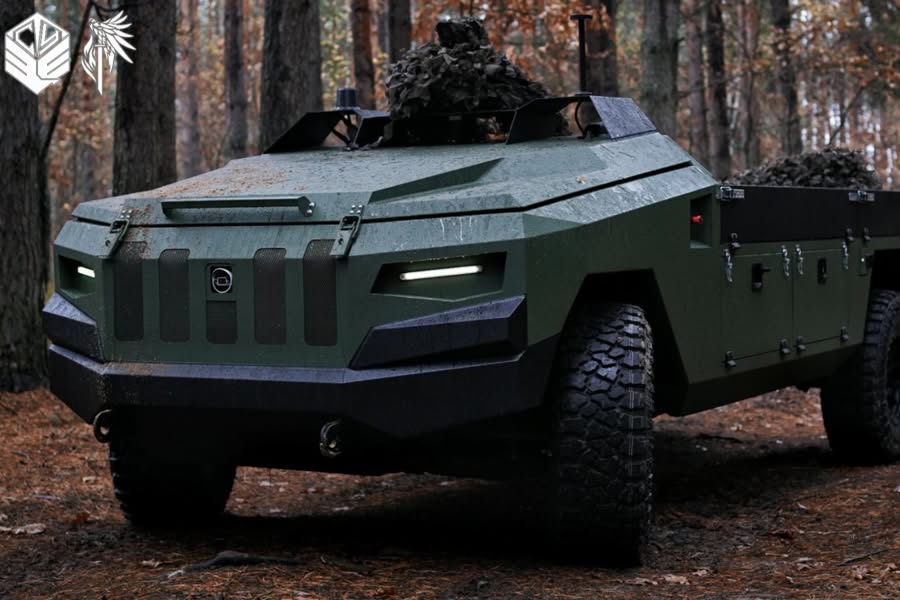
Soldiers from Ukraine's Lava drone regiment, part of the National Guard's 2nd Khartiia Corps, have completed the country's first fully autonomous combat mission with a ground robot, sending an unmanned vehicle roughly 20 kilometers through the Kharkiv sector without a human steering it. An operator supervised the run, but the vehicle itself handled 93% of the route on its own, recognizing the road, dodging obstacles and following a path it had never physically been taught turn by turn.
The mission matters less for its distance than for what it removes from the equation: a person holding a joystick and watching a video feed for an hour while artillery, drones and jamming all compete for attention. Ground robots, often called UGVs, have become central to Ukraine's front-line logistics, but almost all of them are still driven remotely by an operator sitting safely behind the lines. This run was different.
How does a robot drive itself without GPS or a steady signal?
Before the mission, troops used a laser sensor to scan the planned route and build a detailed 3D model of the terrain, down to ruts, craters and tree lines. That map became the robot's internal reference point. Once underway, onboard cameras and sensors compared what the vehicle was actually seeing to that pre-built model, letting it recognize the road surface, spot obstacles and adjust its path in real time, according to Euromaidan Press.
That approach sidesteps the single biggest weakness of remote-controlled UGVs on this battlefield: the radio and Starlink links that carry video and steering commands are exactly what Russian jamming and interceptor drones try to break. A robot navigating from a stored 3D map and onboard sensors keeps moving even when the connection back to its operator gets patchy or cuts out entirely. The autonomy software running underneath comes from Apex.AI, a company based in Palo Alto and Munich that builds navigation stacks for unmanned ground vehicles, with Lava soldiers helping define requirements and running field tests themselves.
Why is Ukraine racing to automate ground logistics specifically?
Resupply and casualty evacuation runs are the most repetitive, and often the most dangerous, missions on the front line, which is exactly why Ukraine has pushed to hand them to machines first rather than, say, offensive strike robots. According to Ukraine's Ministry of Defense, ground robots carried out 31,398 logistics and evacuation missions in October 2026 alone, the highest monthly total since the country's eBalls ground-robot program began. That is roughly 3.3 times the monthly mission count from early in the year, when units ran about 25,143 such tasks in August.
Adoption has widened just as fast as volume: 167 military units were operating ground robots as of March 2026, up from 67 in November 2025. President Volodymyr Zelenskyy has ordered more than 50,000 ground robots deployed across Ukraine's forces during 2026. One officer involved in the program put the logic plainly, saying evacuation runs will likely benefit the most from autonomy because they carry the highest stakes and the greatest responsibility for the crews involved.
Full autonomy on a 20-kilometer route is still a single demonstration, not a fleet-wide capability, and the robot still relied on human supervision rather than operating completely unsupervised. But it signals where Ukraine's unmanned systems forces are heading next: away from robots that need a constant human hand on the controls, and toward ones that can keep moving through exactly the conditions, jamming, dead zones and sustained fire, that make remote piloting hardest.