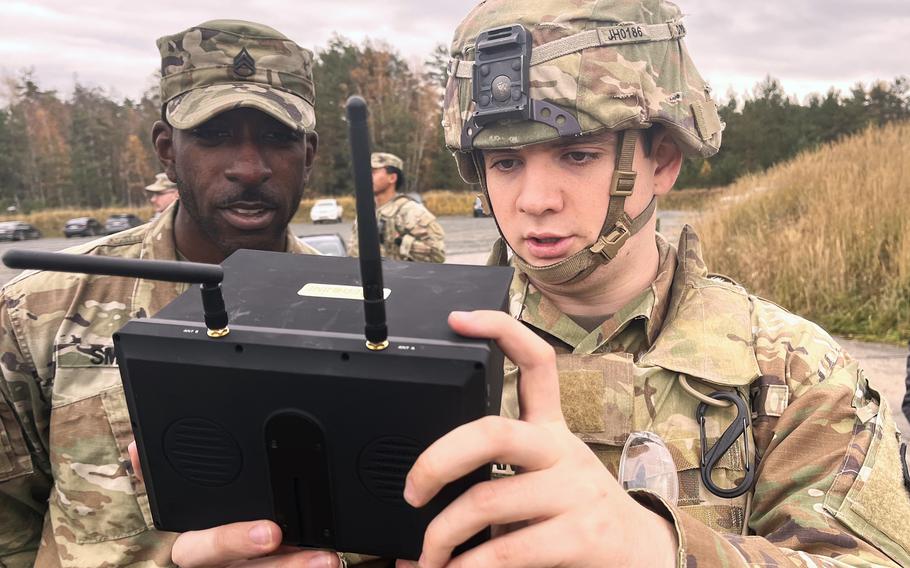
US Army soldiers tested a drone-launching unmanned ground vehicle at the Grafenwoehr Training Area in Bavaria, Germany, on November 12, 2026, firing 18 drones from a single ground robot in a field trial designed to overwhelm enemy air defenses, according to Stars and Stripes. The trial also launched drones from shipping containers and forest positions, combining ground vehicles equipped with Javelin anti-tank missile launchers and HIV3 drone-firing systems. Soldiers from the 173rd Airborne Brigade, working with the Army's Combat Capabilities Development Command and US Army Europe and Africa, ran the exercise under the Army's Remote Rapid Response Contingency Team program, which pre-positions drones and unmanned vehicles in containers at strategic locations.
The test falls under the Eastern Flank Deterrence Initiative, the Army's effort to protect NATO territory. Col. Michael Weisman said the systems tested \"allow the U.S. and its allies to slow or stop advancing enemy forces,\" while program manager Alex Tomosieski said the approach \"provides a standoff in both time and space and provides multiple dilemmas for the adversary.\" Cpl. Tyler Dooros, one of the drone operators, put the shift in blunter terms: \"Instead of putting more troops on ground, we're putting more drones on ground, which obviously is going to be exponential for us.\"
Why Ground-Launched Swarms Change the Math
Most drone saturation tactics discussed since the Ukraine war have focused on air-launched swarms or hand-launched first-person-view drones. Firing 18 drones from a single unmanned ground vehicle shifts the economics: ground robots can carry more airframes, reload faster than a soldier on foot, and operate from positions too exposed for a manned crew. Pairing that with containerized drone caches, which can sit dormant along likely invasion routes for months, lets the Army create ambush points without permanently stationing troops or air defense radar at the site. That combination is specifically aimed at the kind of mechanized advance NATO planners expect along its eastern border, where attackers would otherwise rely on air superiority to clear a path for ground forces.
How This Fits the Broader Counter-Drone Arms Race
The test sits alongside a wave of similar programs: Ukraine's own ground-based drone launchers, NATO's new counter-drone equipment marketplace, and US industry efforts from Anduril and Shield AI on swarming autonomy software. What distinguishes the Grafenwoehr trial is its focus on offense rather than defense, using drones to saturate and exhaust air defense systems rather than to intercept incoming threats. If the Remote Rapid Response Contingency Team concept scales beyond this trial, it would give forward-deployed US units in Europe a persistent, low-manpower way to contest airspace before an adversary's armor crosses the border, shifting some of the burden from expensive manned aircraft and air defense batteries onto disposable, container-stored drone stocks.