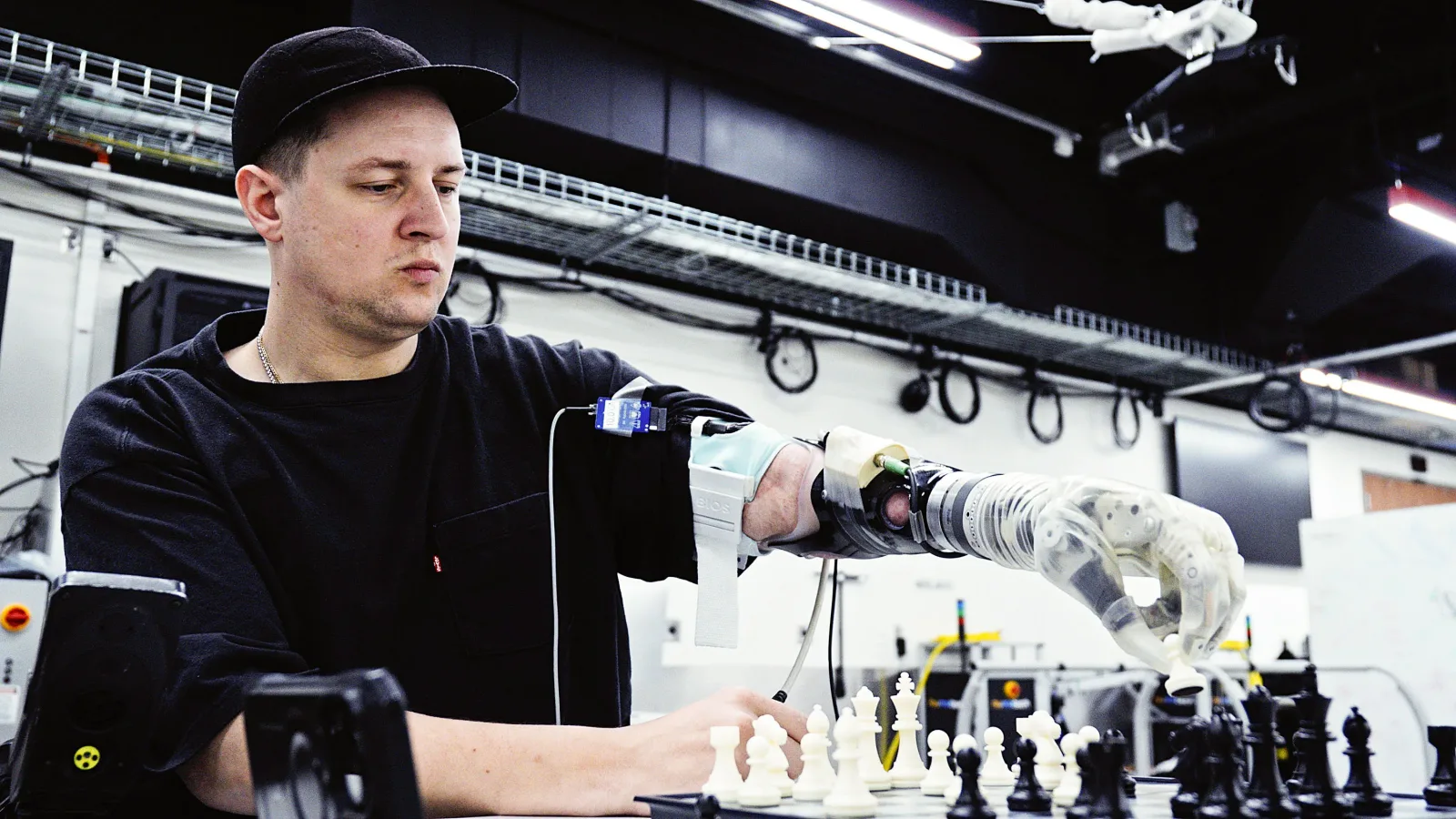
A University of Utah clinical trial has sent an experimental prosthetic hand home with a patient for the first time, giving Avi Davidson, 33, the ability to feel pressure and texture through fingers he lost in a 2009 accident. Davidson, the ninth person to receive the implant, began using the device independently at his house on July 10, 2026, after surgery in late January, according to MIT Technology Review.
Wiring a hand to send signals both ways
The device, known as the LUKE Arm — a reference to Luke Skywalker's robotic hand in Star Wars — was first approved by the FDA in 2014 after trials that began in the 2000s. What makes Davidson's case notable is not the hand itself but the nerve interface layered on top of it: a 100-needle electrode array implanted in three nerves in his forearm, plus 24 additional muscle electrodes, creating a two-way connection that both reads his intended movements and pushes sensory signals back in the other direction.
Jake George, who directs the university's neurorobotics lab, described the core engineering problem as deceptively simple: "Where do I put the damn thing?" — the question of exactly where in the forearm's nerve bundles to place electrodes so that stimulating them produces sensations that map cleanly onto specific fingers and types of touch. Occupational therapist Leanne Seckinger worked with Davidson to calibrate that mapping, a process he said took about three days before sensations started to feel reliable rather than arbitrary.
From minutes to seconds, with real stakes attached
The gains are measured in ordinary tasks that depend on touch, not just grip strength. Davidson can now write his name in seconds rather than minutes, handle fragile objects like grapes and eggs without crushing them, chop ingredients, and hold his wife's hand well enough to feel it holding back. Those are capabilities that grip-force sensors alone cannot fully deliver — a prosthetic can clamp down on an egg without breaking it through careful calibration, but doing that reliably across dozens of everyday objects generally requires feedback a user can actually feel, rather than one they have to watch for visually every time.
Chris Duncan, a rehabilitation physician and chief medical officer at BIOS, the neurotechnology company supporting the trial, is working alongside the University of Utah team as the study moves from a small research cohort toward something closer to a product. The trial is designed to run for at least a year, putting its current phase on track to conclude around January 2027, and the team says it is now planning a larger study aimed at the FDA approval pathway that would make insurance coverage possible.
That regulatory step is the real bottleneck for sensory-feedback prosthetics generally. Research-grade systems with implanted electrode arrays have existed in academic labs for years, demonstrating impressive touch discrimination in controlled settings; the harder problem has been building a version durable and simple enough for a patient to wear unsupervised, day after day, without a research team nearby to troubleshoot it. Davidson's five months of independent home use — described in the trial as unprecedented for this device — is the first real evidence that the gap between lab demonstration and daily-life prosthetic might be closing.
Davidson's prosthetic also carries a smaller, almost incidental detail that captures how uneven access to this technology still is: before his upgrade, he used a secondhand mechanical hand he had bought on eBay. The distance between that stopgap and a nerve-connected hand that can feel a chess piece or a spouse's fingers is the distance the LUKE Arm program is now trying to close for a wider group of patients, not just the nine who have had the implant surgery so far. If the planned larger study eventually wins broader FDA clearance for the sensory-feedback components, the device would move from a handful of trial participants to something insurers might actually pay for — historically the step where promising neuroprosthetic research stalls rather than scales.