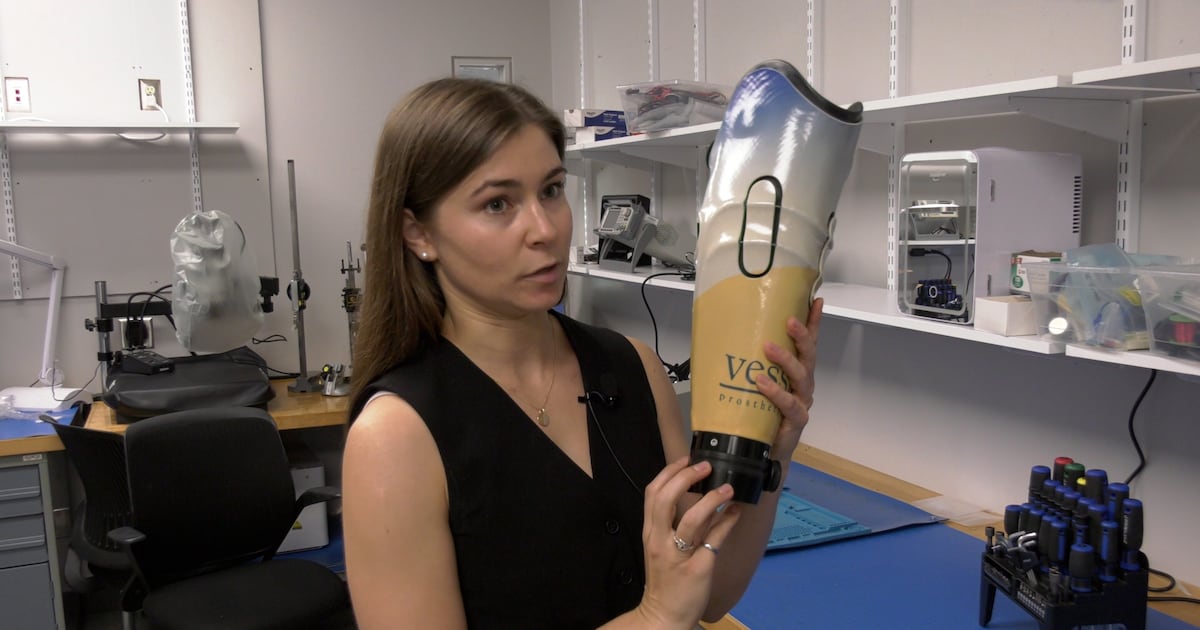
London, Ontario-based medtech startup Vessl Prosthetics has secured U.S. Food and Drug Administration clearance for the Kinn Automatic Volume Management System, an adaptive socket platform designed to end one of the most persistent daily frustrations in lower-limb prosthetics: residual limb volume that shifts throughout the day and steadily unseats the fit patients depend on for mobility.
Turning steps into automatic fit
Unlike vacuum, elevated-vacuum or pin-lock socket systems, Kinn is passive and continuous. The socket harvests kinetic energy from the wearer's normal gait and translates it into micro-adjustments that keep the socket snug against the residual limb as tissue swells, shrinks or migrates. Amputees no longer have to add or remove sock plies through the day, and clinicians no longer have to re-cast for volume drift that used to require repeated fittings.
Clinical case for adaptive sockets
Vessl's launch materials cite research showing that 48% of amputees and 65.7% of clinicians identify socket fit as the single biggest barrier to comfort, mobility and successful rehabilitation. Poor fit drives skin breakdown, gait deviations, secondary joint injuries and, in the worst cases, abandonment of the prosthesis altogether. Kinn's isoform socket format is intended to protect skin health while preserving the rotational stability and shock absorption needed for activities from stairs to running.

Founder-driven engineering
Chief executive Sydney Robinson, an engineer who co-founded the company after graduate research at Western University, told CTV News London that FDA clearance is the milestone Vessl has been building toward since it started prototyping with US Navy veteran and athlete Stevie as an early user. The clearance opens U.S. commercial distribution and joins a growing wave of intelligent prosthetic hardware, including Phantom Neuro's neural-interface prosthetic work and MIT's artificial-muscle fiber research.
Rollout and clinician network
Vessl is opening a waitlist for U.S. providers and expanding its clinician training program alongside the launch. The company frames Kinn as complementary to advanced control layers coming from the neural side of the field, filling a gap that even the most sophisticated microprocessor knee cannot close: the socket-limb interface itself. For context on adjacent robotics research reshaping how humans interact with machines, see coverage of Psyonic's dexterity partnership with ABB and EPFL's neural vision prosthetics work.
Reporting based on coverage from CTV News London, Vessl Prosthetics and Medical Innovation Xchange.