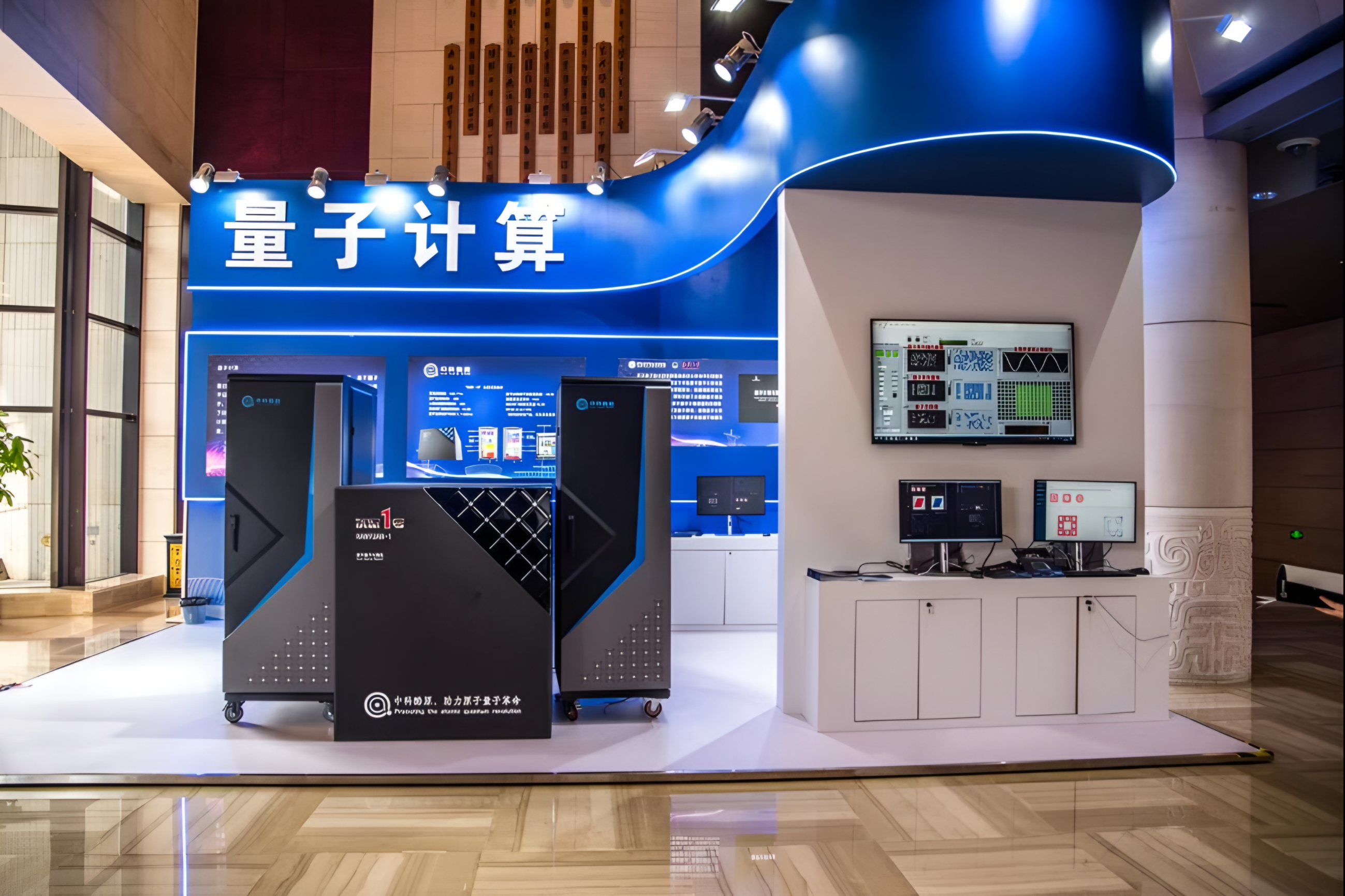
A startup that did not exist a year ago walked into the World Artificial Intelligence Conference on Saturday and showed a quantum computer built to slide into an ordinary server rack. Zhongqi Wuliang, a Shanghai Institute of Optics and Fine Mechanics (CAS SIOM) spinoff, unveiled the Qinghe No. 1 at WAIC 2026 on July 18, 2026, pitching it as the first neutral atom quantum computer engineered for direct data-center deployment — no dilution refrigerator, no vibration table, no dedicated quantum facility required.
Why Removing The Refrigerator Changes The Deal
The engineering barrier that has kept quantum hardware in laboratories is not the qubits themselves; it is the cryogenic support system. Superconducting machines from IBM and Google cool their circuits to roughly 15 millikelvin in dilution refrigerators that fill dedicated rooms. Neutral atom systems sidestep the constraint at the architectural level: individual atoms are trapped in vacuum using optical tweezers and manipulated with laser pulses, and cooling is self-contained inside the vacuum chamber. Two-qubit gates run through the Rydberg blockade — one atom excited to a high-energy state detunes its neighbor from a laser pulse — at microsecond speeds. That is slower than superconducting nanosecond gates, but the room-temperature operating envelope is a structural commercial advantage that no gate-speed comparison captures.
What Was Announced, And What Was Not
Zhongqi Wuliang was founded on March 3, 2025 by CAS SIOM's Lu Xudong and completed its integrated hardware stack within months of founding. The company describes Qinghe No. 1 as a second-generation server form factor unit targeting near-term quantum advantage in financial optimization, logistics and materials simulation. It reports "internationally competitive performance," but has not published qubit count, two-qubit gate fidelity, coherence time or any peer-reviewed benchmark. That gap is the most important part of the announcement. The predecessor Hanyuan-1 shipped to a paying China Mobile customer and secured 40 million yuan in orders after publishing its numbers; Qinghe No. 1 has not cleared that same bar.
China's Nine-Month Three-Generation Cadence
Qinghe No. 1 arrives as the third commercially positioned Chinese neutral atom system in nine months. In October 2025, Zhongke Kuyuan delivered Hanyuan-1 to China Mobile — a 100-qubit system running in three racks at room temperature with 0.999 single-qubit and 0.98 two-qubit fidelity. In May 2026, the same lineage produced Hanyuan-2, a dual-core cabinet design consuming under 7 kW. Qinghe No. 1 pushes the form factor further still, to a single standard server rack. No other national quantum program has matched that cadence. Shanghai's Xuhui Cultivation Zone and Zhangjiang Quantum Bay hubs are the industrial policy engine behind the pattern.
The Field Just Got Validated
Zhongqi Wuliang's debut lands in a global neutral atom sector that has received unusually strong endorsement. In March 2026, Google Quantum AI opened a dedicated neutral atom research laboratory in Boulder led by JILA physicist Adam Kaufman, running the modality in parallel with its superconducting flagship. The chipmakers powering AI infrastructure are watching closely. QuEra's Gemini system operates at 260 physical qubits with above 99.2% two-qubit fidelity, and a Harvard/MIT/QuEra Nature paper in January 2026 demonstrated below-threshold error suppression on a fault-tolerant architecture with up to 448 atoms. Pasqal, Atom Computing and Infleqtion are also advancing commercial neutral atom platforms.
What Buyers Should Ask Before Any Order
Any enterprise evaluating Qinghe No. 1 should require the same technical validation applied to Western quantum hardware: published qubit counts, gate fidelity across multiple rounds, coherence times and third-party replication. Zhongqi Wuliang is a CAS spinoff operating under Chinese law, which means Article 7 of China's National Intelligence Law applies regardless of stated policies — a legal fact that matters for enterprise workloads even when the device itself does not collect consumer data. U.S. export controls on quantum hardware to Chinese entities remain in force. What the announcement demonstrates is real: the data-center form factor for quantum hardware is within reach of current engineering, and the cryogenic barrier keeping quantum out of the enterprise is lower than the superconducting story implied.
Reporting based on coverage from Tech Times, Pandaily, Quantum Computing Report and Global Times.