Chinese embodied-AI developer AGIBOT has released Genie Operator-2 (GO-2), a next-generation foundation model that the company says bridges the "last mile" between high-level reasoning and precise physical execution within a single unified architecture.
Closing the semantic-actuation gap
GO-2 is the successor to GO-1, the ViLLA-architecture model AGIBOT launched a year ago to unify vision, language and action. While GO-1 taught robots to interpret instructions and plan tasks, AGIBOT says real-world deployments exposed a persistent fracture between reasoning and execution, the so-called semantic-actuation gap, in which control modules drift from the model's own plans and accumulate errors over long-horizon tasks. GO-2 is engineered specifically to close that gap so robots not only reason about the world but act on it with consistent stability.
Two architectural innovations
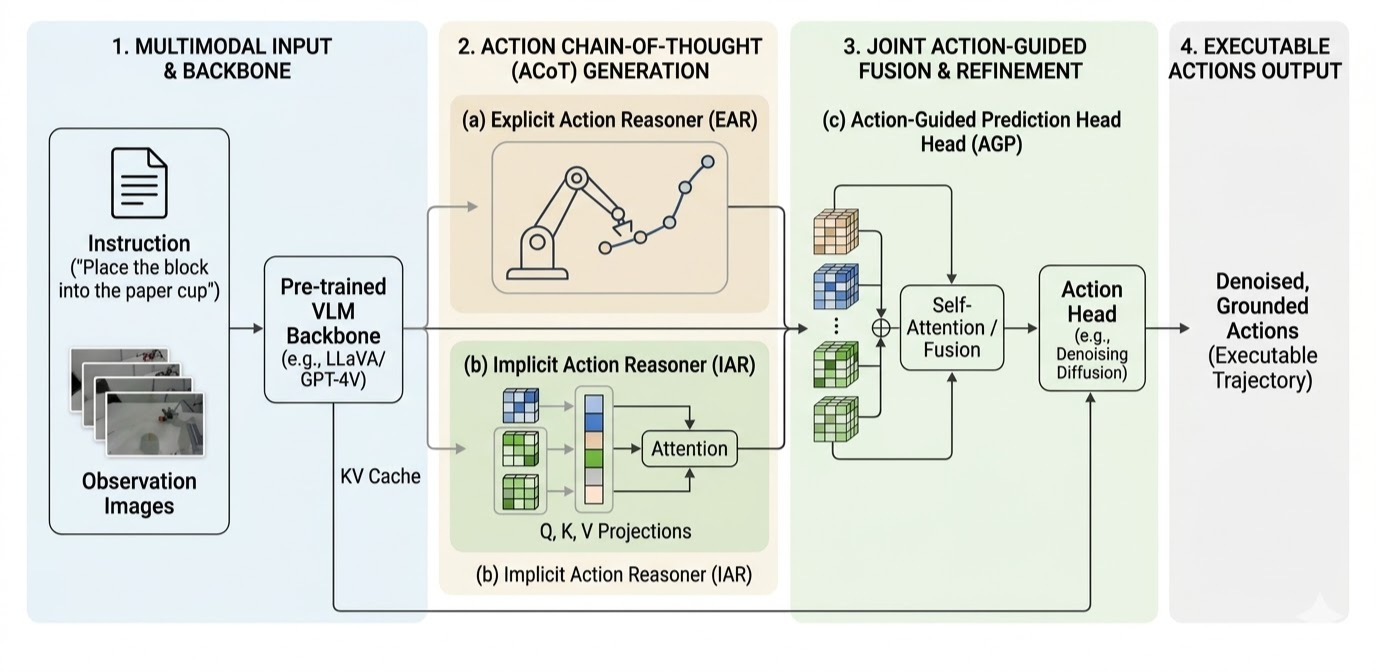
The model rests on two ideas. The first, Action Chain-of-Thought, performs reasoning directly in action space: GO-2 generates a sequence of action intents as a macro-plan, much as a person mentally rehearses a basketball shot before releasing the ball, then executes it step by step. The second is an asynchronous dual-system design that pairs a low-frequency Semantic Planning Module, acting as a "general commander," with a high-frequency Action Following Module that behaves as an "agile executor," continuously compensating for noise and disturbances. AGIBOT trained the system with a teacher-forcing mechanism so execution stays faithful to reasoning even under imperfect plans. The two contributions have been accepted to CVPR 2026 and ACL 2026 respectively.
State-of-the-art benchmarks
AGIBOT says GO-2, trained on tens of thousands of hours of interaction data, outperforms mainstream models including Physical Intelligence's pi-0.5 and NVIDIA GR00T. It reports an average 98.5% success rate across the LIBERO benchmark's spatial, object, goal and long-horizon tasks, an 86.6% zero-shot success rate on the disturbance-heavy LIBERO-Plus, and an 82.9% real-world success rate when trained solely on simulation data in Genie Sim 3.0. Integrated with the company's Genie Studio development platform, GO-2 also supports continuous data collection, cloud-based collaborative training and online post-training, which AGIBOT claims delivers roughly 10x better training efficiency and lifts success rates two-to-four-fold while cutting data requirements by more than half.
From understanding to acting
The release extends a wider industry push toward general-purpose physical AI, echoing efforts such as Genesis AI's Eno general-purpose robot and NVIDIA's Cosmos world foundation models. AGIBOT, which has also showcased its hardware alongside NVIDIA's Isaac GR00T humanoid stack, framed GO-2 as the moment embodied foundation models move "from understanding the world to acting upon the world."
Reporting based on coverage from AGIBOT and The Robot Report.