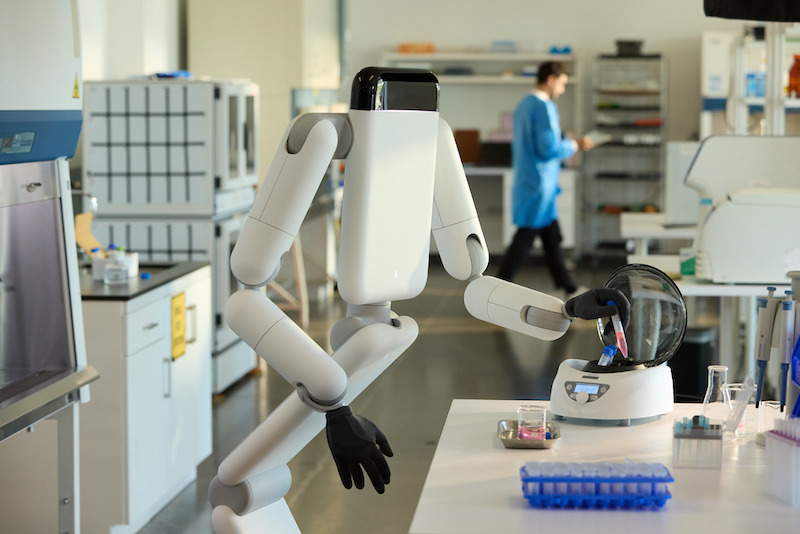
Genesis AI has unveiled Eno, the company's first general-purpose robot, marking the full-stack robotics startup's move from foundation models into shipping hardware. Rather than copying the humanoid form favoured by most rivals, Eno rises from a wheeled base into a minimalist tower of articulated panels that can change the robot's height and reach in real time, then fold down for compact storage.
Form built around capability, not appearance
Genesis AI says Eno is designed around human capability rather than human looks, prioritising mobility, dexterity and real-world functionality. At the centre of the system are arms fitted with the company's proprietary dexterous hands, which match the form and function of human hands so the robot can use tools, objects and environments already designed for people. "We reduced the form to its essential elements so that every detail serves a purpose," said head of design Daniel Hundt.
One brain, one body: GENE inside Eno
Eno was engineered in tandem with GENE, Genesis AI's robotics-native foundation model, so body and brain are optimised as a single integrated system. GENE gives Eno human-level dexterous manipulation with millimetre precision and lets it operate as a true physical agent: understanding a high-level goal, retaining memory, reasoning through changing conditions and dynamically planning multi-step tasks over long periods. The approach builds directly on the company's earlier GENE-26.5 foundation model and custom robotic hands.

Deployments this year
Genesis plans to begin Eno's production and targeted customer deployments by the end of 2026, starting with industrial customers in manufacturing, logistics and laboratories, then service settings such as hotels and hospitals, before consumer applications. CEO Zhou Xian called Eno "an important step forward for what general-purpose robots can help society achieve." Investor and former Google CEO Eric Schmidt framed it as "a fundamentally new model for extending human capability through advanced robotics."
The launch lands amid a fierce embodied-AI race that includes Figure's humanoid deployments, XPeng's Iron humanoid and warehouse players such as Sereact. Genesis AI has raised $105 million in seed funding from backers including Eclipse, Khosla Ventures, Bpifrance and HSG, and says Eno is the first step in a broader robot roadmap with additional embodiments in development.
Reporting based on coverage from Robotics & Automation News and Genesis AI.