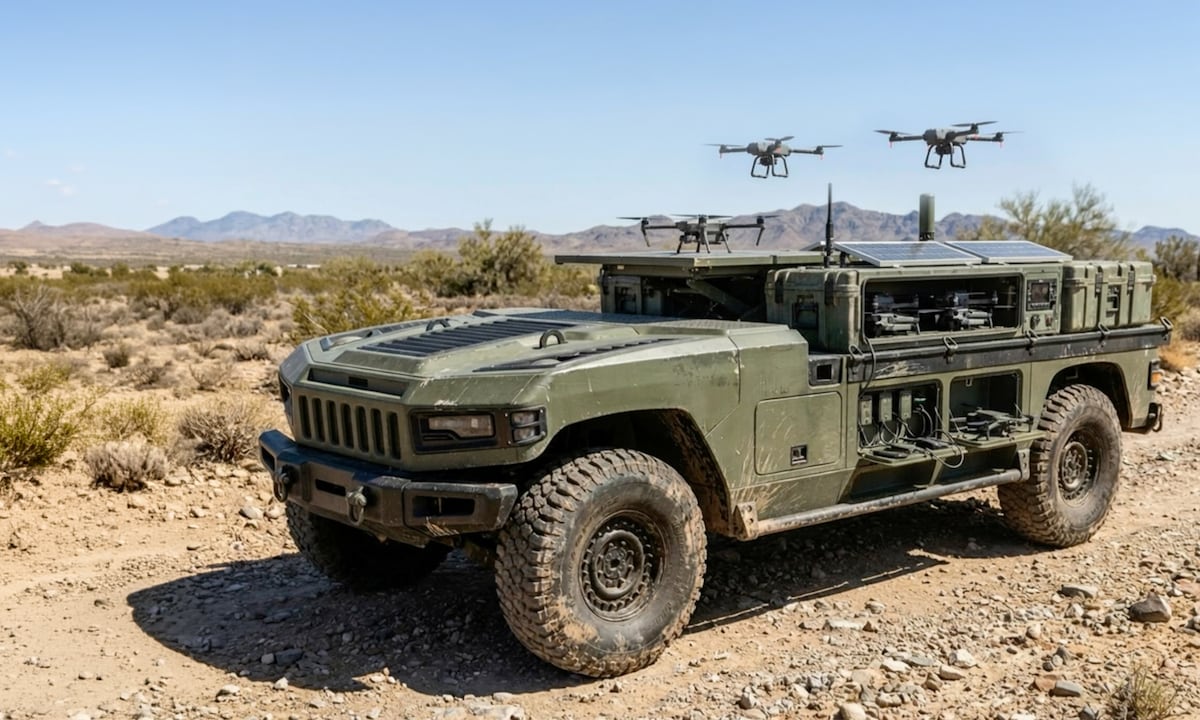
AM General will unveil a new modular autonomous unmanned ground vehicle at Eurosatory 2026 in Paris, developed in partnership with Textron Systems and Carnegie Robotics, the Humvee maker said ahead of the June 15-19 trade show. The platform marks AM General's most aggressive autonomy push to date and signals how the South Bend, Indiana manufacturer plans to defend its tactical vehicle franchise against a wave of robotic competitors.
Modular Chassis, 6,000-Pound Payload, Counter-UAS Weapon
The new UGV combines an AM General chassis with drive-by-wire technology, a 250-horsepower engine and a payload capacity of up to 6,000 pounds, designed to support logistics, reconnaissance, casualty evacuation and armed overwatch missions. At Eurosatory, the platform will be displayed with the Hornet Remote Weapon Station, an integrated counter-UAS turret designed to engage small drones from a stationary or on-the-move firing solution. The mission-payload bay is built for rapid swap-outs between unarmed cargo, sensor masts and weapon stations.
The Autonomy Stack: Textron Systems And Carnegie Robotics
Textron Systems is the lead autonomy integrator, drawing on its existing work on the Aerosonde unmanned aircraft and the TSUNAMI interceptor unmanned surface vessel, while Pittsburgh-based Carnegie Robotics contributes the perception stack and sensor fusion. The collaboration positions AM General alongside Milrem Robotics, AeroVironment and Anduril in the autonomous ground vehicle race, with Textron Systems handling the open architecture autonomy stack.
Eurosatory's UGV Wave
The AM General reveal is part of a broader Eurosatory 2026 UGV wave that also features Renault and John Cockerill's small reconnaissance prototype, Milrem Robotics' THeMIS and HAVOC family covered in our piece on the Dutch THeMIS production line, and Ondas Holdings' Iron Wave robotic combat suite covered in our earlier Iron Wave preview. Together the announcements underline how counter-UAS capability has become the through-line of land robotics in 2026.
Why It Matters For The Pentagon's M-MET Push
The US Army's M-MET request for proposal, expected later in 2026, is hunting for a UGV capable of supplying frontline troops and evacuating casualties across the most dangerous segment of the battlefield. AM General's combination of a familiar tactical chassis, modular payloads and a Textron-Carnegie autonomy stack is calibrated to score on M-MET's requirements without forcing the Army to absorb an entirely new logistics tail. The same platform, with the Hornet C-UAS package, could also compete in counter-drone task orders flowing under the Perennial Autonomy IDIQ vehicle.
Reporting based on coverage from Defense News, Shephard Media and Army Recognition.