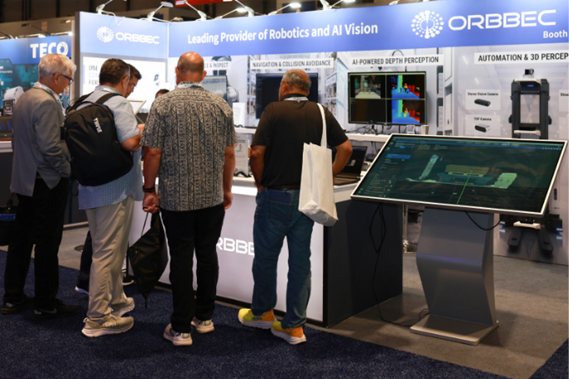
Orbbec brought its latest generation of industrial 3D vision systems to Automate 2026 in Chicago this week, pairing high-precision depth hardware with on-device AI to tackle the perception problems that still stall factory and warehouse robots. The Shenzhen-based company, which says it has equipped more than 1,600 robotics firms worldwide, used the show to position itself at the convergence of machine vision and edge AI.
AI-enhanced depth for industrial blind spots
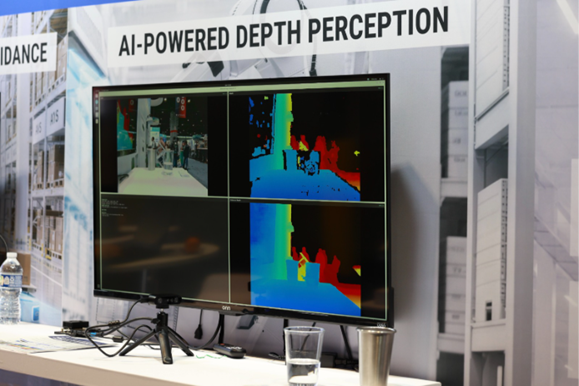
Transparent containers, low-texture walls and highly reflective metal remain notorious failure cases for conventional depth cameras. To address them, Orbbec partnered with Robbyant — the robotics arm of Ant Group — to launch LingBot-Depth for its Gemini 330 Series. The enhanced depth filter feeds chip-level depth data into Robbyant's vision-language-action models, and Orbbec says incorporating high-quality depth directly into large models measurably lifts manipulation success rates.
The filter runs on NVIDIA Jetson Orin hardware, using CUDA and TensorRT for real-time edge inference such as depth hole filling, noise removal and edge refinement — capabilities aimed at carton-edge tracking in logistics, reflective-metal alignment in assembly and transparent-vessel handling in lab automation.
New cameras built for the factory floor
Orbbec showcased a customizable 3D DLP structured-light camera delivering roughly 0.07 mm accuracy and 0.05 mm Z-repeatability at half a meter, designed for precision assembly and inspection. It also demonstrated an automated forklift running on the industrial-grade Gemini 435Le stereo camera, and the ultra-compact Gemini 305g, a wrist-mountable sensor with GMSL2/FAKRA connectivity built to survive vibration and electromagnetic interference.
Validation through global deployments
The vision push lands amid intense investment in physical AI and the data pipelines that feed it. At Automate, Teradyne Robotics used Orbbec's Gemini 305g cameras inside its Universal Robots AI Trainer, a platform for collecting the high-quality data needed to train manipulation models. Orbbec claims more than 70% share of China's service-robot vision market and a similar lead in South Korea's mobile-robot segment, and is expanding manufacturing in Foshan and a new base in Vietnam to reach an annual capacity exceeding six million robotic units.
The announcements echo a broader industry move toward tightly integrated perception stacks, seen in efforts such as ABB's physical AI toolchain, Vention and Teradyne's digital-twin cobot cells and tactile-manipulation benchmarks like Daimon Robotics and Galbot's RobOmni.
Reporting based on coverage from The Robot Report and Orbbec.