Researchers at Washington University in St. Louis have developed a durable, platinum-free catalyst that produces clean hydrogen from water, a step that could make renewable hydrogen cheaper and easier to scale. The work was published in the Journal of the American Chemical Society.
Replacing expensive platinum group metals
Many clean-energy technologies remain costly because they rely on platinum group metals (PGMs). A team led by Gang Wu, a professor of energy, environmental and chemical engineering, set out to remove that dependency in an anion-exchange membrane water electrolyzer (AEMWE), a device that uses renewable electricity to split water into hydrogen and oxygen.
"Going from water to hydrogen is a very desirable way we are able to store energy for different applications," Wu said. "Hydrogen itself can be used as an energy carrier and is useful for different chemical industries and manufacturing."
How the catalyst works
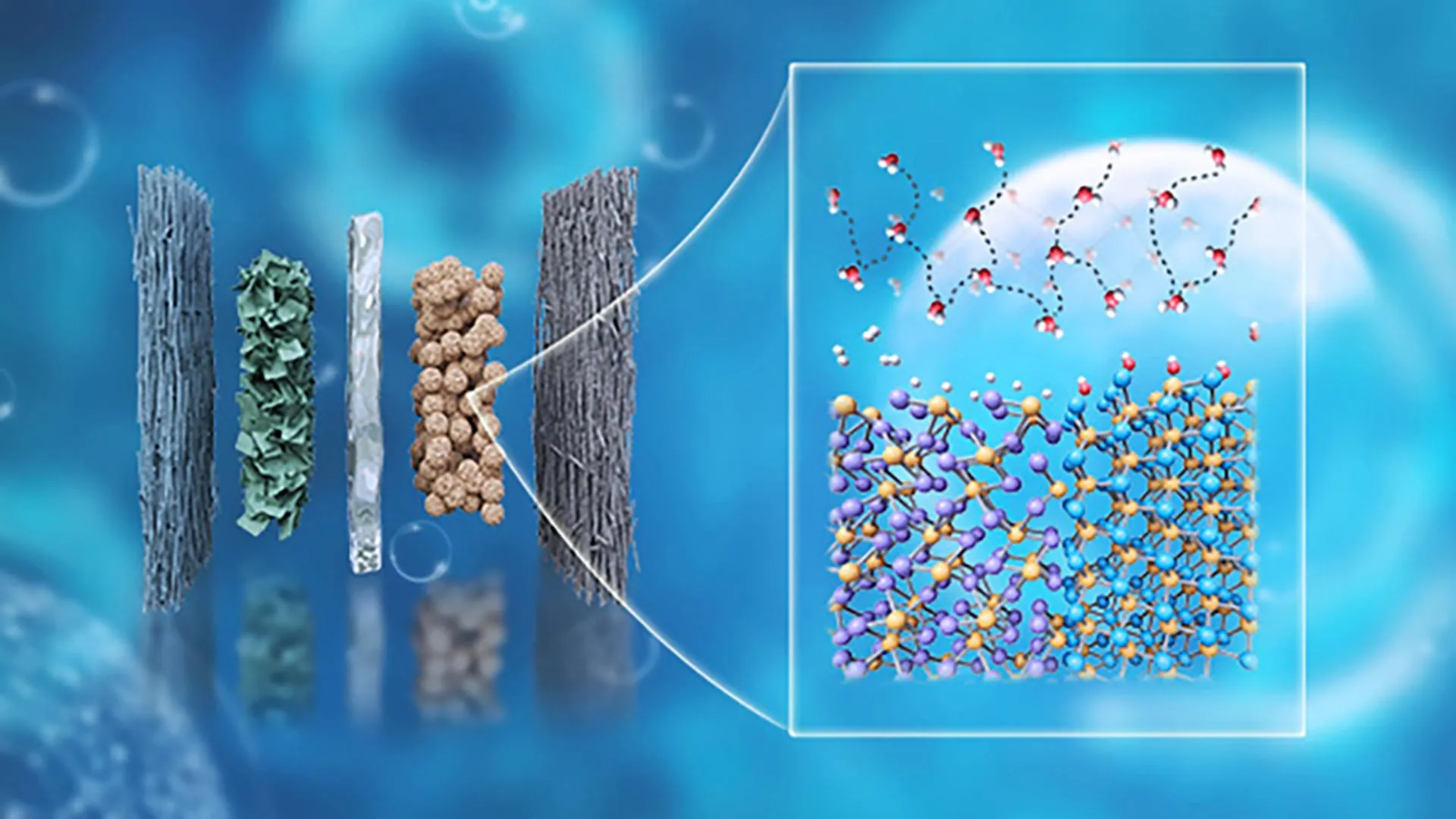
The researchers combined rhenium phosphide (Re2P) and molybdenum phosphide (MoP) into a composite that improved hydrogen extraction. The rhenium component helped hydrogen attach to and release from the catalyst surface, while the molybdenum sped up the splitting of water in the alkaline electrolyte. Paired with a nickel-iron anode, the system outperformed a leading state-of-the-art cathode, including one based on PGM materials.
Durability built for industry
Crucially, the catalyst operated for more than 1,000 hours at industrial current densities of 1 and 2 amperes per square centimeter, making it one of the most durable platinum-free cathodes yet reported for these electrolyzers. Wu said engineering the hydrogen-bond network at the catalyst-electrolyte interface was key to achieving fast reaction kinetics and low resistance. The advance sits alongside other materials-science breakthroughs reshaping clean technology.
A complement to renewables and storage
Because the process can be powered by electricity from sunlight, wind or water, low-cost hydrogen could become a flexible way to store surplus renewable energy and decarbonize heavy industry. It offers an alternative pathway to chemical battery storage for long-duration needs. The experiments were conducted at laboratory scale, and the team plans to study whether the technology can be expanded for industrial use.
Why low-cost hydrogen matters
Green hydrogen, made by splitting water with renewable electricity, is widely seen as a way to decarbonize sectors that are hard to electrify directly, such as steelmaking, fertilizer production and long-haul transport. But its cost has been held back by reliance on scarce platinum group metals in the electrolyzers. By matching or beating PGM-based cathodes with abundant rhenium and molybdenum phosphides, the Washington University team points to a route that could lower system costs without sacrificing performance. The study, "Designing a Dry Cathode via Hydrogen-Bond Network Regulation at Phosphide Heterostructure/Electrolyte Interfaces for Alkaline Water Electrolysis," appears in the Journal of the American Chemical Society and was supported by Wu's startup fund at the university.
Reporting based on coverage from ScienceDaily and Washington University in St. Louis.