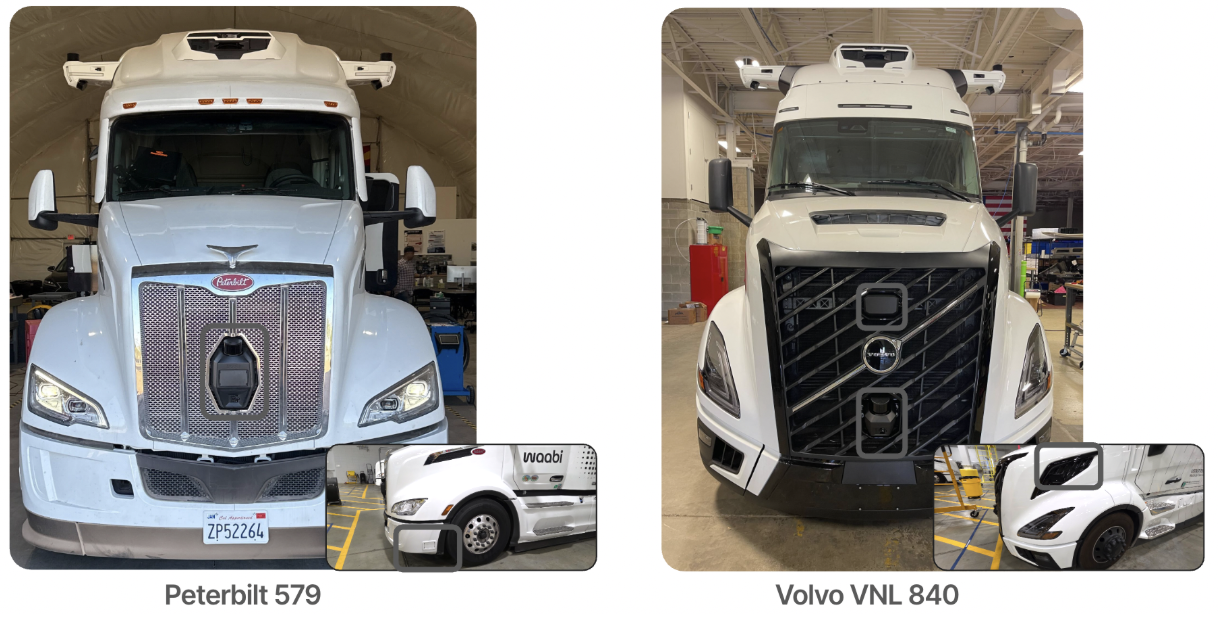
Waabi Driver Transfers Zero-Shot to Volvo VNL Autonomous Truck
Waabi's Physical AI virtual driver, trained on a Peterbilt 579, drove Volvo's VNL Autonomous safely on highways and city streets on the first mile — without any new data, simulation or fine-tuning.
Key Takeaways
Waabi's virtual driver, trained on a Peterbilt 579, transferred zero-shot to the Volvo VNL Autonomous truck, driving highways and city streets safely from the first mile with no new data, simulation, fine-tuning or engineering.
The demonstration, disclosed June 26, 2026 with Volvo Autonomous Solutions, involved a different truck body, sensor stack, control system and physical geometry, yet matched the performance Waabi reported for its Peterbilt fleet.
Waabi frames zero-shot embodiment transfer as the second major frontier of self-driving generalization; CEO Raquel Urtasun called it 'a defining moment for Physical AI.'
The result supports Volvo's US freight strategy anchored on the VNL Autonomous and shows the platform can accept multiple virtual drivers, per Volvo Autonomous Solutions President Nils Jaeger.
Waabi raised roughly $1 billion in early 2026 (investors include NVIDIA, Uber, Khosla Ventures, Volvo Group Venture Capital) and runs a single end-to-end interpretable AI model trained in its Waabi World simulator, the architecture enabling cross-embodiment transfer.
Kaan Tınmaz
Toronto-based autonomous trucking startup Waabi and Volvo Autonomous Solutions say the Waabi Driver generalized zero-shot to the Volvo VNL Autonomous truck, driving highways and complex city streets fully performant from the very first mile without any new real-world data, simulation data, fine-tuning or engineering.
What Waabi actually demonstrated
The Waabi Driver was originally trained on a Peterbilt 579. In the joint experiment disclosed on June 26, 2026, Waabi installed the same AI model onto the Volvo VNL Autonomous — a different truck body with a different sensor stack, control system and physical geometry — and drove it on public roads. Waabi and Volvo say the system performed autonomously across mixed highway and surface-street mileage, without additional training or hand-tuning, matching the behaviour Waabi previously reported for its Peterbilt-based fleet.
Why zero-shot embodiment transfer matters
Autonomous-truck deployments have historically been locked to one platform — engineers spend months re-collecting data and revalidating stacks each time the target vehicle changes. Waabi frames zero-shot embodiment transfer as the second big frontier of generalization for self-driving, after generalizing across environments and behaviors. Waabi CEO Raquel Urtasun called it "a defining moment for Physical AI," and Volvo Autonomous Solutions President Nils Jaeger said it demonstrated the scalability of Volvo's autonomous-truck platform to accept multiple virtual drivers and vehicle models.
Ties to Volvo's autonomous roadmap
The Volvo VNL Autonomous is the truck Volvo Autonomous Solutions has picked to anchor its US freight strategy. Waabi and Volvo have been public partners since at least October 2025, and the zero-shot result gives both sides an argument for commercial scale that other AV programs still lack. It also sharpens Waabi's position at the intersection of trucking and robotaxi work — the same AI model recently expanded to surface streets, and Waabi has said it plans to use the same brain on both trucks and robotaxis.
Where Waabi stands in the autonomous-vehicle stack
Waabi raised roughly $1 billion at the start of 2026, with investors including NVIDIA, Uber, Khosla Ventures and Volvo Group Venture Capital. The Waabi Driver runs a single end-to-end interpretable AI model — trained and validated in Waabi's simulator, Waabi World — rather than a modular perception/planning stack. That architecture is what makes cross-embodiment transfer plausible in the first place, and it now looks like the sharpest technical differentiator Waabi has in a crowded self-driving market.
Reporting based on coverage from Waabi, Volvo Autonomous Solutions, Heavy Duty Trucking and Truck News.
What does zero-shot transfer mean in Waabi's Volvo VNL demonstration?
It means the exact AI model trained on a Peterbilt 579 was installed on the Volvo VNL Autonomous and drove public highways and city streets fully performant from the first mile, without any new real-world data, simulation data, fine-tuning or engineering.
Why is zero-shot embodiment transfer important for autonomous trucking?
Autonomous truck deployments have historically been locked to one vehicle platform, requiring months of data re-collection and revalidation for each new truck. Zero-shot transfer removes that barrier, making it faster and cheaper to scale a virtual driver across multiple vehicle models.
How does Waabi's architecture enable this transfer?
The Waabi Driver is a single end-to-end interpretable AI model, trained and validated in the Waabi World simulator, rather than a modular perception/planning stack. That unified design is what makes cross-embodiment generalization plausible.
What is the relationship between Waabi and Volvo?
Waabi and Volvo Autonomous Solutions have been public partners since at least October 2025. Volvo Group Venture Capital invested in Waabi's roughly $1 billion early-2026 funding round, and the VNL Autonomous anchors Volvo's US freight strategy.