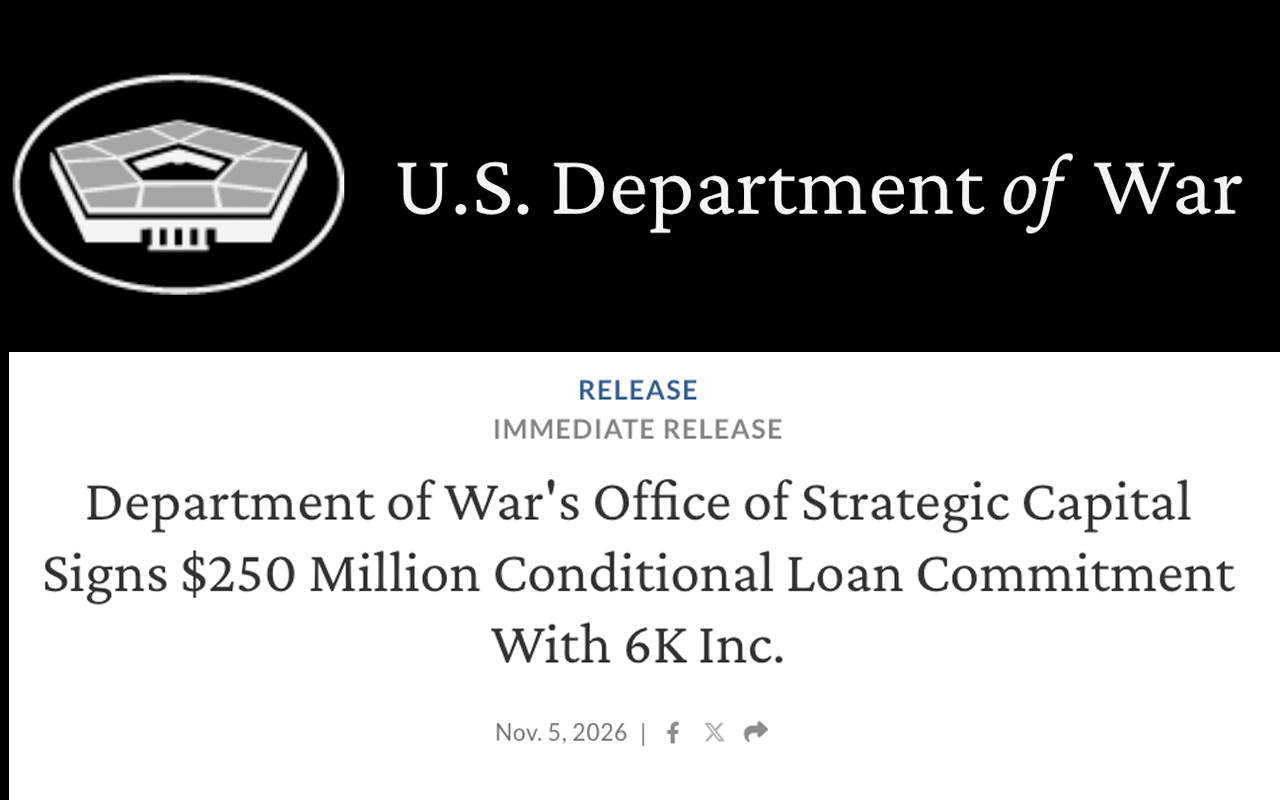
6K Inc. has received a conditional loan commitment of up to $250 million from the U.S. Department of War to build a domestic factory that makes the materials inside lithium-ion battery cathodes. The commitment, announced November 5, 2026 through the department's Office of Strategic Capital, will fund construction of 6K's PlusCAM plant in Jackson, Tennessee. It's debt, not equity, so no new valuation was attached to the deal. The Massachusetts-based company says the 160,000-square-foot plant will employ about 230 people once it reaches full capacity, according to 6K Inc.
What does 6K actually build?
Cathode active material, or CAM, is the powder packed into the positive end of a lithium-ion battery. It's the ingredient that determines how much energy a cell can hold and how fast it can charge. Most CAM plants make it through a multi-step wet-chemistry process involving precursor chemicals and long reaction times.
6K instead uses a process it calls UniMelt, which pushes raw metal feedstock through a microwave-generated plasma plume briefly hotter than the surface of the sun. That heat fuses the ingredients directly into battery-grade powder, skipping several conventional processing steps. The company says the approach cuts water use and shortens the path from raw material to finished product. 6K already runs a separate facility in Burgettstown, Pennsylvania, that uses the same plasma technology to make metal powders for 3D printing.
The Jackson plant will produce two common cathode chemistries, NMC (nickel manganese cobalt) and LFP (lithium iron phosphate), covering both the high-energy-density batteries used in electric vehicles and the cheaper, more stable chemistry often chosen for stationary energy storage.
Why is the Pentagon funding a battery materials company?
Most of the world's cathode material supply, and nearly all of the specialized processing equipment behind it, currently comes from China. The Department of War's press release frames the loan as a way to reduce dependence on what it calls "Foreign Entities of Concern" for a material it now treats as strategically essential. The release specifically lists defense systems, drones, mobility solutions, energy storage and robotics as the downstream applications that run on the high energy density lithium-ion cells 6K's material would go into.
The $250 million is conditional: 6K still has to clear financial, legal, technical and regulatory due diligence before any money changes hands. CEO Saurabh Ullal said the goal is "a resilient and competitive U.S. battery supply chain" built on "proven technologies that are scalable."
This isn't the first federal dollar behind the Jackson site. The U.S. Department of Energy already awarded 6K a $50 million grant for the same facility back in December 2023, so the War Department loan stacks on top of existing public support rather than starting the project from scratch.
How does this compare to the rest of the battery materials race, and what's next?
6K has raised roughly $475 million across more than 30 funding rounds over its history, including an $82 million Series E round in 2024, before going public on Nasdaq in December 2025. The new War Department loan is the largest single piece of capital tied to one project that the company has disclosed this year.
It competes with a small group of Western cathode and recycling players trying to break China's grip on the material, including Redwood Materials, Sila Nanotechnologies and Novonix, alongside legacy chemical producers that still dominate global volume. None of those rivals has yet announced a comparable federal loan of this size for a single U.S. plant.
What to watch: whether 6K clears the remaining due-diligence conditions and locks in the loan at financial close, how quickly the Jackson plant moves from groundbreaking to shipping commercial volumes, and whether the Office of Strategic Capital extends similar support to other domestic battery material producers as Washington keeps pushing supply-chain independence from China.