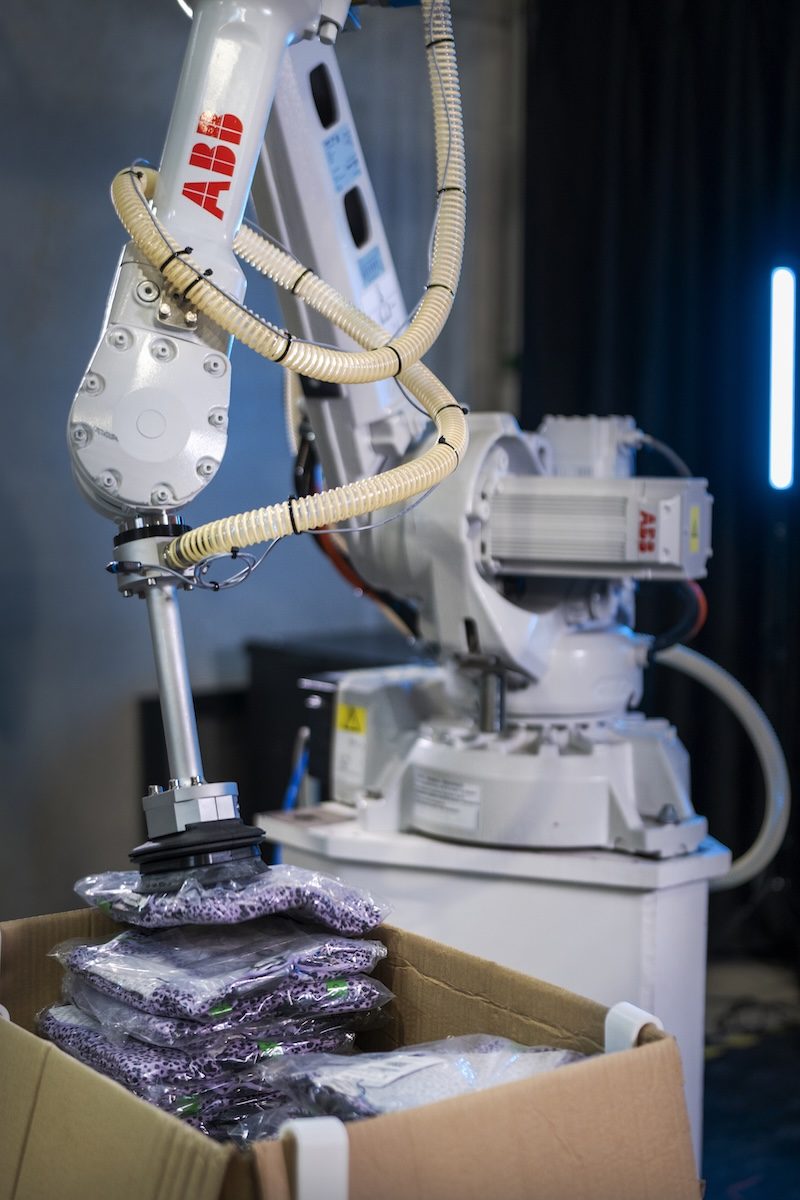
ABB Robotics launched an updated version of its Fashion Inductor module on November 14, integrating the company's AI Robot Trainer vision system for the first time to automate garment sorting and induction in fashion logistics centers. ABB says the combined system can process up to 1,300 items per hour per cell at better than 99.5% picking accuracy, while cutting engineering and commissioning effort for system integrators by as much as 75%.
The pitch centers on pre-trained, fashion-specific AI vision models that recognize soft, deformable items like folded garments and poly-bagged clothing — notoriously harder for machine vision than rigid boxes. ABB pairs that with a digital twin connecting its RobotStudio software and OmniCore controllers, plus what it calls a continuous closed-loop workflow that lets the vision model keep improving after deployment. "Physical AI fundamentally changes what robots can do in industrial applications," said ABB's McDonnell, framing the release as reducing project risk for integrators rather than just adding a new feature.
Garments are the stubborn holdout in warehouse automation
Boxes and rigid totes have been solved problems in robotic sortation for years — companies like Geek+ and Cainiao have pushed warehouse autonomy well past single-task picking. Clothing is different: garments shift shape, bunch inside poly bags, and vary wildly in texture and reflectivity, which is exactly why fashion logistics has lagged behind grocery and general e-commerce in robotic adoption. By targeting that specific gap with pre-trained fashion models rather than a general-purpose vision system, ABB is betting that narrow, vertical-specific AI beats a one-size-fits-all approach for picking accuracy.
ABB's real competition is the integration cost, not just rival robots
ABB already sold Fashion Inductor as a hardware sorting module; what is new is strapping AI Robot Trainer onto it to cut the setup burden integrators have long complained about with vision-guided robotics. That 75% reduction in commissioning effort matters more than the throughput number, because setup time is usually where automation projects blow their budgets and timelines. It also mirrors a broader move by ABB this year to push AI Robot Trainer across multiple verticals — the company has signaled plans to extend the same approach into other vision-based applications through early 2027.
The competitive risk is that ABB is not the only industrial robotics giant chasing vertical-specific physical AI. Mech-Mind, Fanuc and Yaskawa all sell vision-guided picking systems, and fashion retailers increasingly have the option of going with specialist robotics-as-a-service vendors rather than incumbents like ABB. ABB's advantage is distribution: it already has OmniCore controllers and RobotStudio software installed across thousands of existing cells, so an upgrade path is cheaper to sell than a rip-and-replace system from a smaller rival. Whether 1,300 items an hour holds up outside controlled demos, and whether fashion retailers are willing to retrain staff around the closed-loop model, will determine if this becomes a real deployment wave or stays a trade-show statistic.