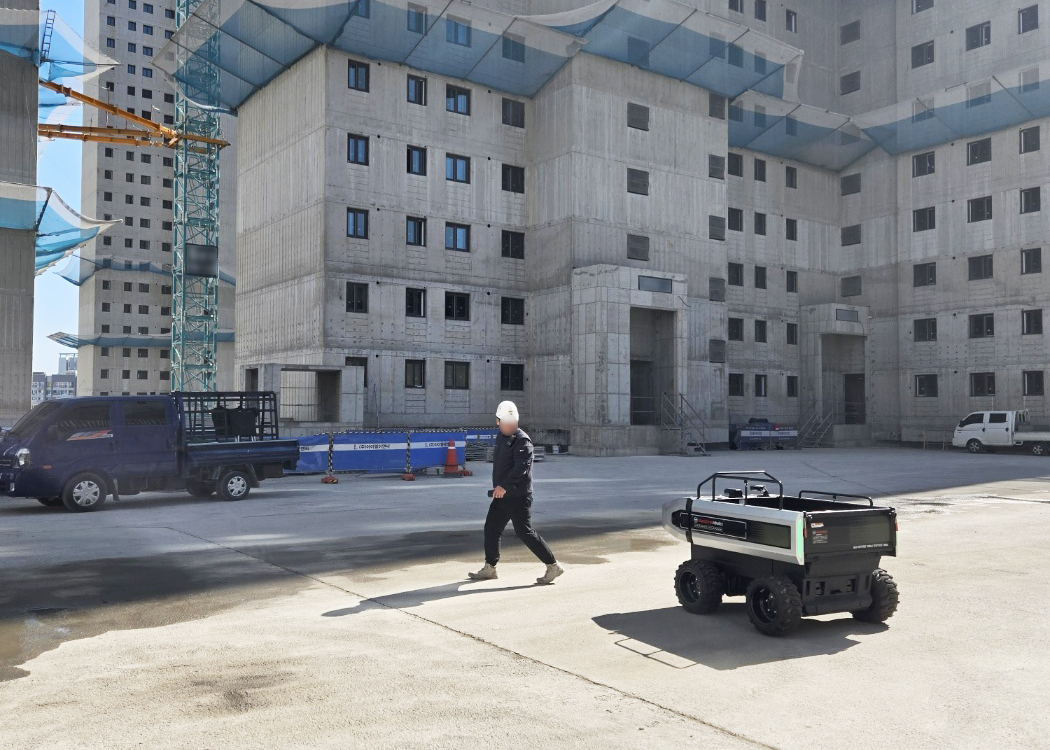
For years, Daedong Robotics built the RT100 to haul feed and harvested crops across the uneven ground of orchards and open fields. Now the same four-wheel-drive machine is carrying masonry, plaster and finishing materials up the ramps of an apartment building under construction in the western Seoul metropolitan area, after builder GS Engineering & Construction ran a proof-of-concept trial with the robot from October 7 to October 30, 2026, according to Seoul Economic Daily.
The RT100 follows workers around a site using a target-tracking system and can also be driven by wireless remote control that the company says requires minimal training. Its four-wheel-drive chassis is built to handle slopes and bumps that would stall a standard wheeled cart, a feature inherited directly from its agricultural roots. During the trial, Daedong said the robot performed steadily on uneven surfaces and eased the physical burden on workers who otherwise haul materials by hand.
Why Builders Are Testing Farm Robots
Construction sites and farm fields share a problem that has made both industries slow to automate: terrain. Factory and warehouse robots can rely on flat floors and fixed infrastructure, but hauling materials across a half-finished building or a muddy orchard row requires the same kind of rugged mobility. Daedong, an affiliate of Korea's Daedong Group, built the RT100 for agriculture first and is now repositioning it as a construction hauling robot, betting that solving rough-terrain mobility once lets it sell into both markets rather than building a separate machine for each.
GS E&C signed a memorandum of understanding with Daedong in June 2026 before running the October trial, a sequence that suggests the construction firm is evaluating the robot for a wider rollout rather than a one-off pilot. South Korea's construction industry has faced a persistent shortage of skilled site labor, particularly for repetitive material-moving tasks, giving builders a direct incentive to test automation that can work alongside existing crews rather than replace entire job functions.
What Daedong Plans Next
Daedong says its next development targets include indoor-outdoor autonomous driving for areas with weak satellite signal, automated loading and unloading, and a larger one-ton-plus class robot aimed at heavier construction loads. The company is also building a fleet management system and exploring a robot-as-a-service leasing model, which would let construction firms pay for hauling capacity on a job rather than buying robots outright, lowering the upfront cost that has slowed automation adoption on individual building sites.
The RT100 TS mass-production variant gives Daedong a path to scale beyond pilot projects, and a successful construction rollout would mark one of the clearer examples of an agricultural robot crossing into an entirely different industry rather than a construction-specific machine built from scratch. Daedong has not disclosed commercial pricing or a timeline for a full rollout beyond the completed GS E&C trial.