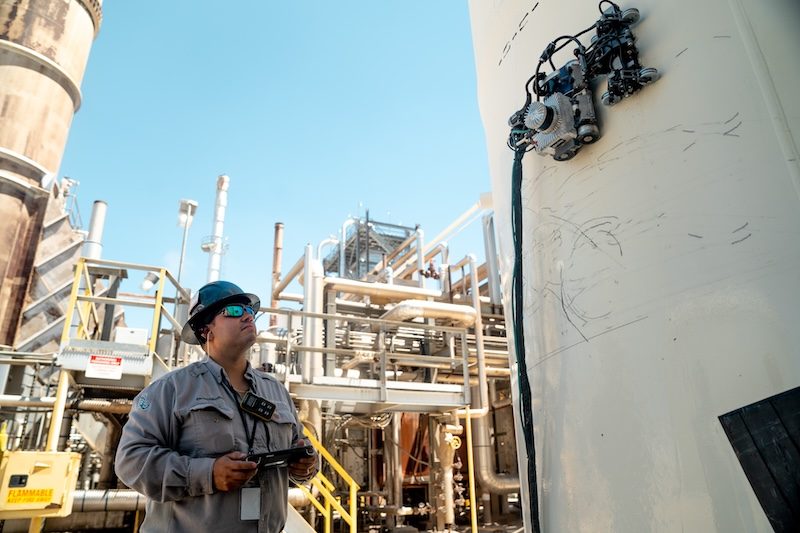
Inside a steel storage tank at an Abu Dhabi refinery, a robot about the size of a lunchbox is being asked to do something most inspection crawlers cannot: pivot through a tight three-point turn without losing its scan line. Gecko Robotics unveiled that machine, called Raptor, at the ADIPEC 2026 energy conference in Abu Dhabi, naming the Abu Dhabi National Oil Company as its first customer, according to Robotics & Automation News.
Raptor climbs, crawls and scans pipelines, storage tanks and other steel infrastructure, capturing millions of data points from each asset it inspects. Gecko says the robot collects data three to five times faster than its existing inspection fleet and up to 20 times faster than competing automated inspection tools on the market. Its improved maneuverability, including the ability to execute tight three-point turns, lets it work through confined spaces and around obstacles that stall older crawler designs.
Why Inspection Speed Is the Real Bottleneck
Industrial inspection has long slowed down oil, gas and power operators, who must take pipelines and tanks offline to check for corrosion, cracking and wall-thickness loss. Every hour a crawler spends scanning a tank is an hour that asset sits idle, so scanning speed translates directly into avoided downtime costs. Gecko's pitch with Raptor is that tripling or quintupling data-collection speed shrinks that window substantially, while pairing the hardware with the company's AI-based software turns raw scans into prioritized repair plans instead of imagery engineers must interpret by hand.
ADNOC's adoption carries weight beyond a single purchase order. The company has publicly pushed to fold AI and robotics into its asset-maintenance operations across its upstream and downstream sites, and Gecko is positioning the ADNOC rollout as the first of several international industrial deployments it plans to announce. Gecko's existing business model already pairs its climbing, crawling, flying and swimming robots with software that models equipment condition over time, so Raptor's speed gains should let the company scan more of a customer's infrastructure within the same maintenance window.
A Crowded Field for Infrastructure Robots
Gecko competes with a growing set of companies chasing the same asset-inspection market, including firms building climbing and crawling robots as well as a wave of drone-based inspection providers serving refineries, pipelines and wind farms. What distinguishes Gecko's approach is its focus on ground-based and climbing robots paired with proprietary data software, rather than treating inspection as a one-off drone flyover. The company has built that software stack around the idea that infrastructure owners need continuous, quantified condition data rather than periodic snapshots, a pitch that has previously won it contracts with shipyards and power utilities.
For the broader robotics industry, Raptor's launch underscores how incremental speed and mobility gains, rather than entirely new sensing technology, are becoming the main competitive lever in industrial inspection. Operators in the Gulf region have been early adopters of automated inspection and monitoring technology as they manage aging steel infrastructure alongside production targets, making the region a logical proving ground before Gecko expands Raptor to customers elsewhere.
Gecko has not disclosed pricing or a timeline for additional customer deployments beyond ADNOC, though the company said further installations with international industrial customers are planned following the initial rollout.