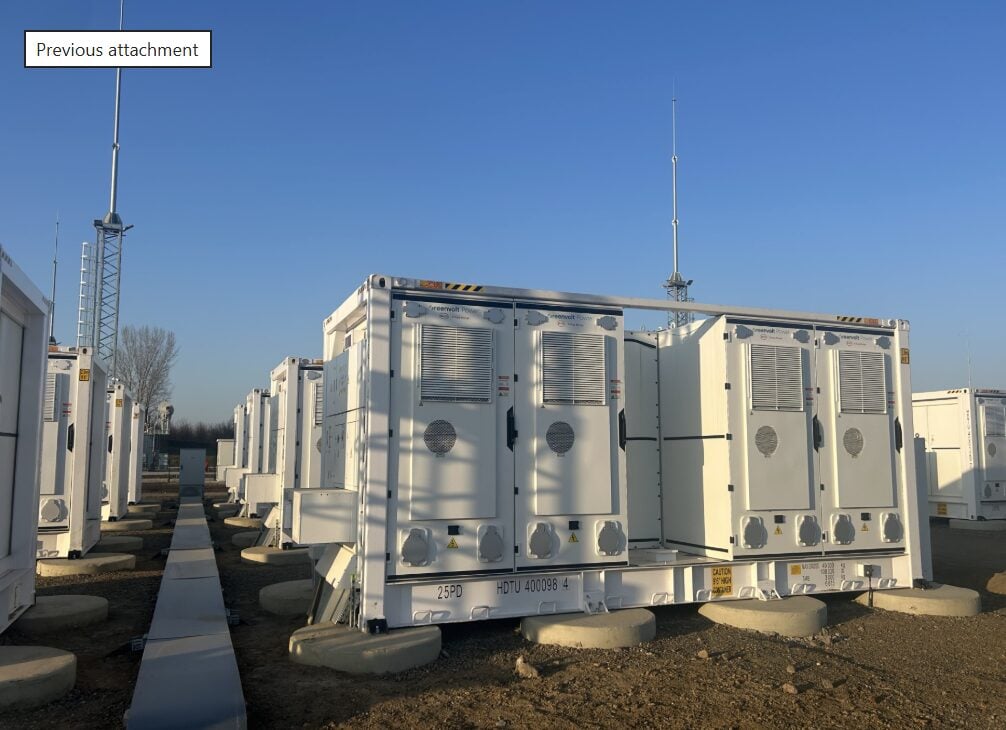
Portuguese renewables and storage IPP Greenvolt Power has put a 99.8 MW / 288.6 MWh battery energy storage system (BESS) into commercial operation at Buj in northeastern Hungary, making it the largest battery storage installation in the country and the wider region.
Two co-located BESS, one record
The Buj project is delivered in two co-located lithium iron phosphate (LFP) battery facilities that combine for the headline 99.8 MW / 288.576 MWh figure. Greenvolt secured a 10-year contract for the project from the Hungarian government under a cap-and-floor subsidy scheme designed to underwrite long-duration storage, and arranged €58.9 million in project finance with UniCredit Bank earlier this year. BYD supplied the battery units, extending the Chinese manufacturer's run of BESS contracts with Greenvolt that also includes 1.6 GWh of projects in Poland.

Buj replaces a 40 MW / 80 MWh BESS commissioned by MET Group in mid-2025 as Hungary's largest single battery installation. The new site will balance the Hungarian grid as renewables continue to grow share, providing fast-frequency response, intraday arbitrage and capacity for the country's nascent ancillary-services markets.
An expanding European BESS pipeline
Greenvolt is also pushing utility-scale battery projects in Poland, Italy and Portugal, generally targeting markets with publicly available subsidies or contracted revenues. The Hungarian announcement landed in the same week as a wider European storage build-out, with developer Aquila securing financing for a 56 MW German merchant BESS, Chint Solar Europe expanding its German portfolio, and Twaice deploying analytics on BayWa r.e.'s 282 MWh Alfeld project.
Cap-and-floor lights the way
Hungary's evolving cap-and-floor regime is becoming a template for other Central and Eastern European storage markets. By guaranteeing a minimum floor revenue while clawing back upside above a cap, the scheme has unlocked debt financing for projects that would otherwise have struggled to attract conservative bank capital. Buj is the most visible product of that policy: a multi-hundred-MWh asset financed on a standalone, contracted basis rather than as part of a renewables co-location structure.
Reporting based on coverage from Energy-Storage.News, CEEnergyNews and The Diplomat Bucharest.