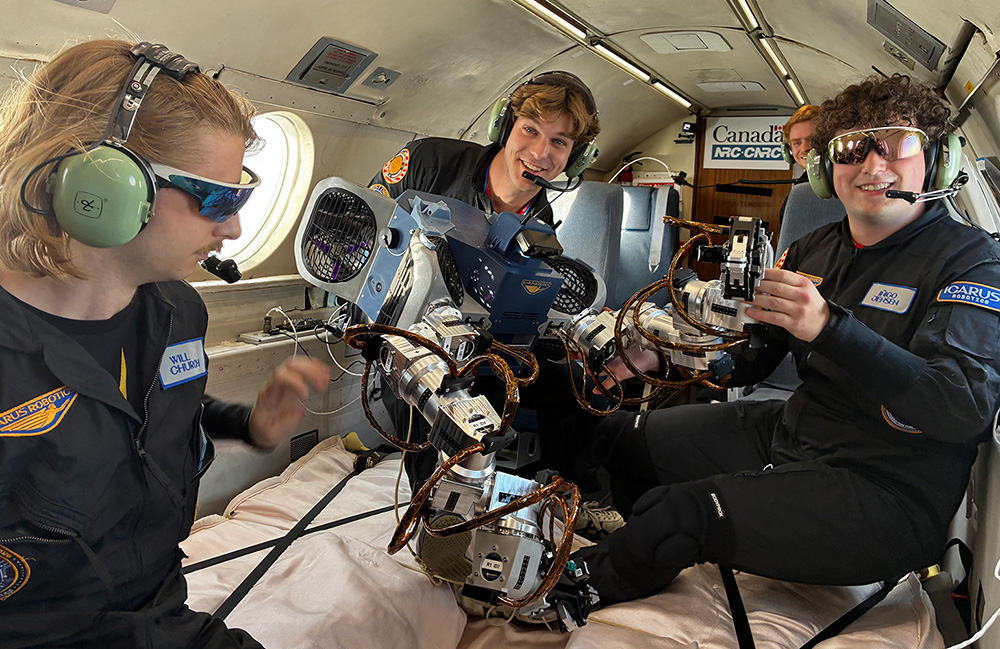
Brooklyn-based Icarus Robotics has flown its free-flying JOY robot in true microgravity for the first time, running 66 parabolas across four flights out of Canada between September 9 and 11. The tests, first reported on September 18 by The Robot Report, exercised JOY's manipulation, state estimation, and flight-control stacks in roughly two cumulative minutes of weightlessness — the last major dry run before the robot ships to NASA in early 2027.
What JOY Is And How It Flew
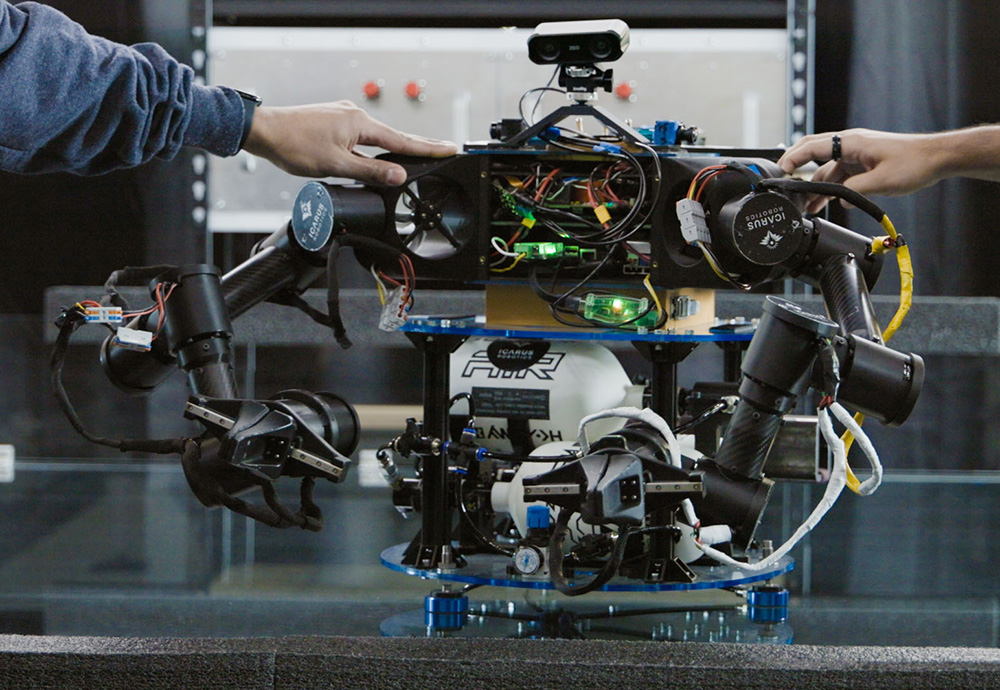
JOY is an intravehicular activity (IVA) robot built to work alongside crew inside the International Space Station. It uses eight fan thrusters for movement, dual 7-DOF dexterous arms with pinch grippers, and stereo depth, time-of-flight and IMU perception, all wrapped around an NVIDIA Jetson Thor T5000 compute stack. "Now we have the confidence to go into January and say that this robot that we will hand over to NASA will operate in the way that we want in microgravity on the ISS," said co-founder and CEO Ethan Barajas.
The May 2027 ISS Mission
Icarus is targeting a NASA hardware handover on January 25, 2027, with launch on the Joyride-1 mission in May 2027 aboard a Voyager Technologies-supported ISS transfer. On orbit, JOY will run in-cabin logistics, sensor-based inspections, and controlled manipulation tests — a live demo of what CTO Jaime Palmer called "all the terrestrial advancements that have happened over the last 10 years in both hardware and software" applied to microgravity.
Where It Fits In A Crowded Space-Robotics Race
Icarus enters a widening in-space robotics field alongside Impulse Space's $808M Series D push into in-space mobility, Open Cosmos' €300M raise for European satellites, and Rocket Lab's 16th Electron of the year. Voyager Technologies, which is helping Icarus reach the ISS, is also positioning itself as a commercial LEO platform operator, and JOY effectively becomes a proof-of-concept payload for a wider class of orbital robot labor. If it works, low-cost dexterous free-flyers could offload routine crew work on future stations — the more mundane end of the humanoid-robot value proposition, in orbit.
What To Watch
NASA still has to sign off on final flight readiness at handover, and Icarus needs to demonstrate JOY can operate for its full duty cycle in ISS thermal, comms and safety envelopes. But with parabolic-flight data now in hand, the question shifts from "will it fly?" to "how much work can it actually do?"
Reporting based on coverage from The Robot Report, SpaceNews and Payload.