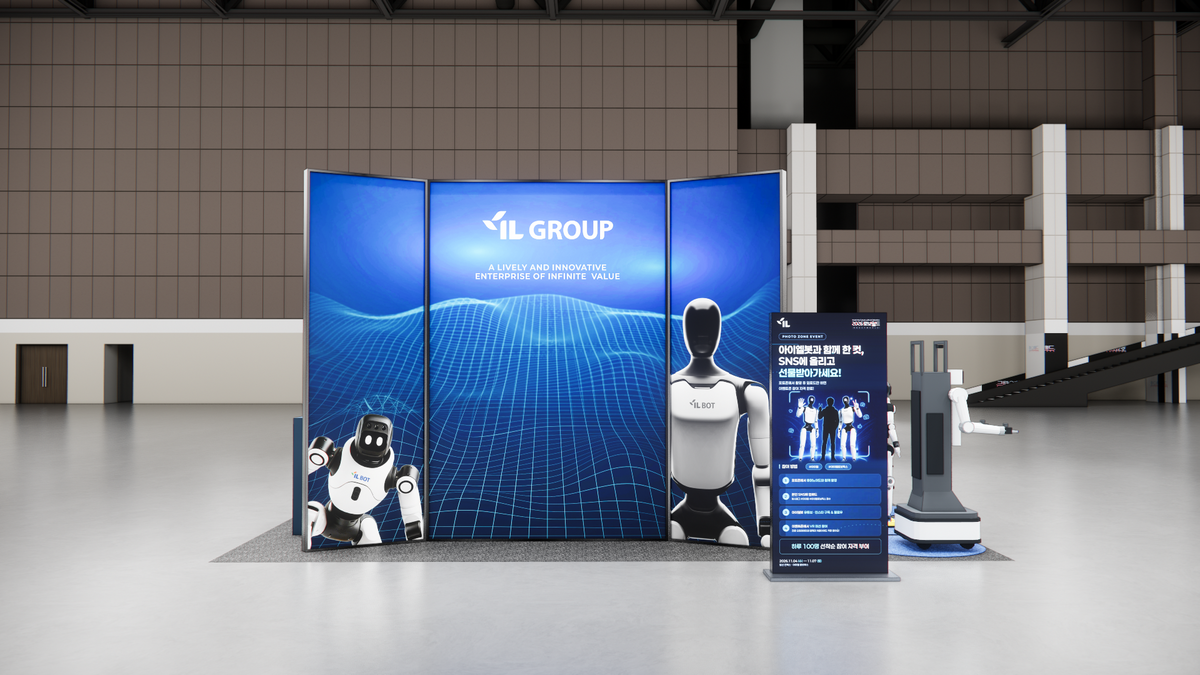
South Korea's IL Corp and its affiliate IL Robotics will jointly exhibit humanoid robots at RoboWorld 2026, running November 4-7 at KINTEX Hall 1 in Goyang, Gyeonggi Province. The headline exhibit isn't a stage demo: IL is showing its ILBOT H2 and Y1 humanoid robots validated as a proof of concept on an active injection molding line at IL Mobility, a group affiliate that manufactures automotive electronic components.
IL describes the deployment process as running through five stages — diagnosis, scenario design, data collection, training and verification — before the robots went on-site for the proof of concept. That pipeline reflects a broader pattern among industrial humanoid programs: rather than dropping a general-purpose robot onto a line and hoping it adapts, companies are running controlled pilots on a single affiliate's production line first, where engineers can tune the robot and the process together before pitching outside customers.
Revenue is starting to follow the robots
The RoboWorld showcase comes days after IL reported record third-quarter revenue of 33.4 billion won (about $23 million), up 14.4% year over year. Roughly 2.7 billion won of that figure was tied directly to the ILBOT humanoid business — a modest slice of total revenue, but a meaningful signal that the unit has moved from research spending to an actual revenue line. Earlier in 2026, IL raised roughly 28.2 billion won (about $19 million) through a third-party rights offering and private convertible bonds to fund the robotics expansion, underscoring how capital-intensive it is to move a humanoid program from prototype to paying customer, even for a company already running factories.
IL Robotics, the affiliate handling commercial rollout, is running a parallel, lower-stakes business at the same show: humanoid robots performing K-pop dance routines three times daily and a VR piloting experience letting visitors directly operate a robot to complete missions. That entertainment and rental business generates revenue with far less engineering risk than factory deployment, and gives IL Robotics cash flow while the industrial side works through longer sales cycles.
A crowded field, but a clearer use case
IL's approach — proving a humanoid on a captive affiliate's line before selling externally — mirrors strategies used by larger players like Agility Robotics, which built credibility with Amazon and GXO deployments before expanding to AGCO and other manufacturers, and Figure AI, which has leaned on partnerships to get robots onto real production floors. IL is a much smaller company by comparison, and its H2 and Y1 platforms haven't been independently benchmarked against competitors from China, the U.S. or Korea's larger conglomerates, several of which are also chasing factory humanoid contracts.
What IL does have is a concrete, named use case — injection molding at an automotive electronics supplier — rather than a generic promise of future flexibility. Whether that single validated process translates into contracts with customers outside the IL group will be the real test of the RoboWorld pitch, and it's a test IL will face with considerably less capital than its larger rivals.
Details of the exhibit were first reported by the Seoul Economic Daily.