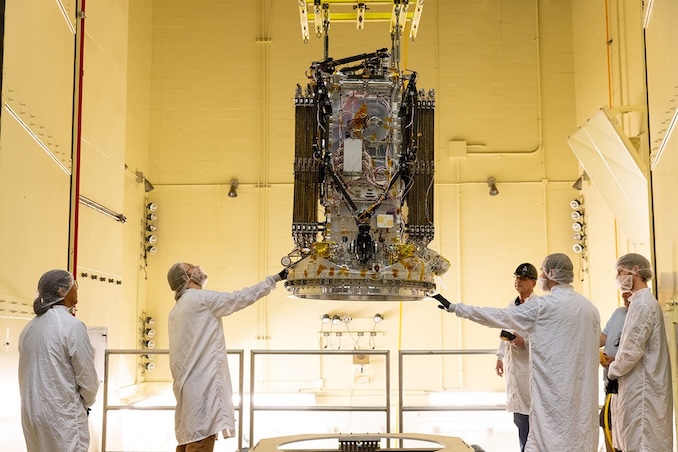
NASA has confirmed that Katalyst Space Technologies' Link servicing spacecraft has cleared environmental testing at the agency's Goddard Space Flight Center, paving the way for an air-launch this month on Northrop Grumman's Pegasus XL to extend the life of the Neil Gehrels Swift Observatory.
Eight Months From Contract To Launch Pad
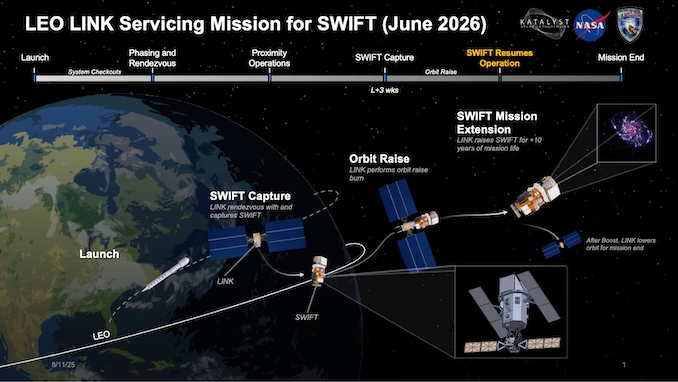
The $500 million Swift telescope, in orbit since 2004, has been dropping from 600 km to 400 km as elevated solar activity drags it down. Without intervention it is expected to re-enter the atmosphere later this year. In September 2025 NASA awarded Katalyst a $30 million contract to build a spacecraft capable of docking with Swift and lifting its orbit. "Katalyst has gotten to this point in just eight months," said Swift mission director John Van Eepoel at NASA Goddard, praising the company's pace through vibration and thermal-vacuum testing that concluded on 4 May.
Three Ion Thrusters, Three Robotic Arms
During testing in Goddard's Space Environment Simulator, Link fired its three ion thrusters and deployed one of its three robotic arms while cycling through hot and cold space-like temperatures. The spacecraft has since returned to Katalyst's facilities in Broomfield, Colorado, for final pre-launch checks before shipment to NASA's Wallops Flight Facility in Virginia for integration with the Pegasus XL.
Why Pegasus XL
Swift's 20.6-degree-inclination orbit ruled out the rideshare manifests of most small-launch vehicles. Katalyst selected Northrop Grumman's Pegasus XL because the air-launched rocket can be released from an L-1011 aircraft over the Marshall Islands at the exact azimuth Swift requires. The mission is one of the first commercial demonstrations of satellite life-extension for a legacy NASA science asset, alongside other satellite-servicing efforts referenced in NASA's expanding orbital platform strategy and broader commercial space push.
Reporting based on coverage from Spaceflight Now, NASA, SpaceNews and Space.com.