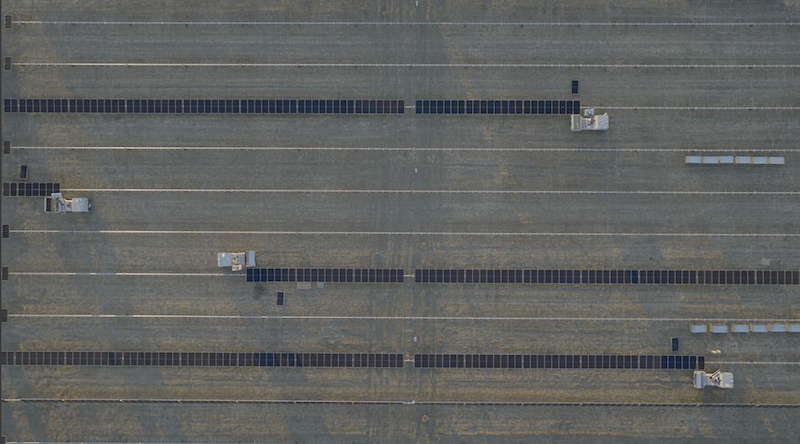
Maximo Robotics said on October 29, 2026 that its autonomous construction systems have completed more than 300,000 tasks across utility-scale solar projects in the United States. The Arlington, Virginia-based company, incubated by power producer AES, builds the Max 4.0 platform, a robotic system that places heavy solar modules with millimeter precision under a pay-per-task service model rather than a traditional equipment sale.
Maximo says crews working alongside Max 4.0 have hit installation rates 2.5 times higher per person per shift hour than fully manual crews. The company's robots are currently active with six engineering, procurement and construction contractors across California, Illinois, Kansas, Louisiana, New York, Texas and Washington, including Primoris Services Corporation's renewables business.
What exactly does the Max 4.0 robot do on a job site?
Max 4.0 handles the physically repetitive, high-volume part of solar construction: lifting and placing modules across sprawling utility-scale arrays with precision tolerances measured in millimeters. The system runs on three components Maximo calls Cortex, its vision and planning AI; Form, the robotics and tooling hardware; and IQ, a fleet-performance platform that feeds field data back into continuous training loops. Maximo says it plans to extend the platform beyond placement into module attachment, site logistics, and cleanup, moving from a single-task tool toward a broader construction labor substitute.
Why is this milestone significant for construction robotics specifically?
Construction has been one of the hardest environments for robotics to crack because job sites are unstructured, outdoor, and change daily, unlike a warehouse or factory floor. Maximo's pay-per-task model is also notable: instead of selling or leasing hardware, it charges EPC contractors for completed work, shifting the operational risk of reliability and uptime onto the robot maker rather than the customer. That is closer to how staffing agencies price labor than how equipment vendors price machinery, and it is one reason Maximo frames itself as a physical-AI platform company rather than a robotics manufacturer.
How does the labor shortage context change the calculus?
Maximo cites a projected shortfall of more than 450,000 US construction jobs by 2027, a number drawn from industry labor forecasts rather than Maximo's own research. Chris Shelton, the company's chief executive, said construction customers depend on safe, productive crews and dependable execution for their clients, framing the robots as a supplement to shrinking crews rather than a replacement for them. Matt Tetrault, president of Primoris Renewables, said the progress has come from close collaboration between craft professionals, project leadership, and the Maximo team refining the technology in real time, rather than the robots operating independently of human crews.
What comes next for Maximo and the broader solar-robotics market?
Maximo says it has a late-stage pipeline for 2027 that is 10 times its current scale, targeting roughly 1.5 gigawatts of solar installation capacity and 3 million additional tasks next year. The company has raised about $41 million to date from investors including Redpoint Ventures, Point72 Ventures and Kleiner Perkins. If Maximo's projections hold, utility-scale solar would become one of the first large construction segments where robots handle a meaningful share of installation labor on live commercial sites, a template other construction-robotics startups are likely to watch closely as they look for their own entry point into a notoriously fragmented industry.