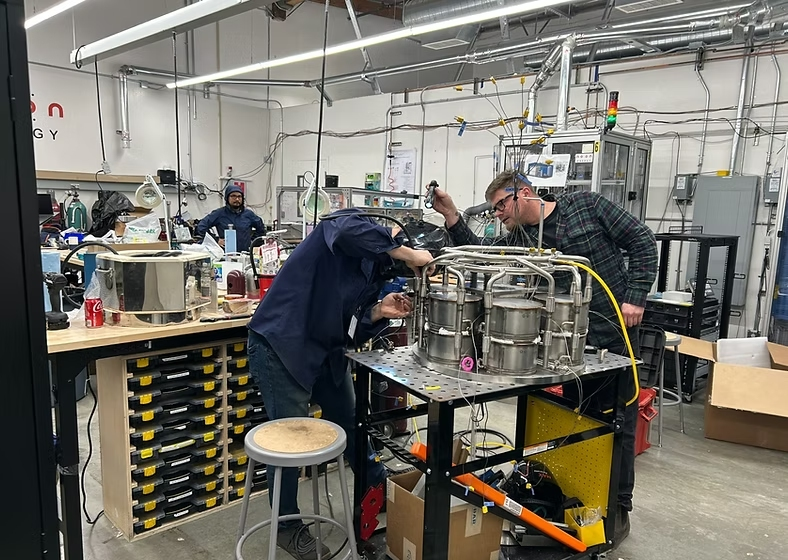

Meta Platforms and California-based Noon Energy announced a supply agreement that reserves up to 1 gigawatt / 100 gigawatt-hours of ultra-long-duration energy storage to power Meta's next-generation AI data centers. The deal, one of the largest commitments to multi-day storage announced to date, will start with a 25 MW / 2.5 GWh pilot expected to be completed in 2028 before scaling to the full 1 GW supply commitment.
How the storage works
Noon's technology uses modular, reversible solid oxide fuel cells paired with a carbon-based active material to provide over 100 hours of continuous discharge - far beyond what lithium-ion battery stacks can offer at grid scale. The architecture stores electricity by reducing CO2 to carbon and oxygen during charging and reverses the reaction to generate power during discharge, with no rare-earth or critical-mineral inputs in the storage medium.
Why Meta needs 100-hour storage
Hyperscale AI data centers now routinely demand multi-gigawatt power draws around the clock, far outstripping local grid headroom in many U.S. regions. Lithium-ion batteries can smooth hours-long renewable gaps but struggle with multi-day weather events. Long-duration storage lets Meta pair contracted solar and wind with firm clean power, reducing reliance on natural gas peakers. The Noon deal complements a parallel agreement Meta announced with Overview Energy to bring up to 1 GW of space-based solar capacity to Earth.
An accelerating energy buildout
Meta has signed roughly 1.8 GW of new clean power contracts with Invenergy across Ohio, Arkansas and Texas, and a separate $1.2 billion solar and battery storage project with Enbridge in Wyoming. The Noon Energy agreement extends Meta's portfolio into the long-duration storage layer that the company says is essential for 24/7 AI compute. The buildout mirrors moves by NVIDIA and TSMC and the broader hyperscaler race for AI infrastructure.
What it means for the LDES market
The contract is a watershed for the long-duration energy storage (LDES) market, which has struggled to find anchor customers willing to underwrite first-of-a-kind deployments. A 1 GW commitment from a hyperscaler validates the technology for utilities and grid operators that have been waiting on bankable demand signals. Noon said deliveries under the full supply contract will begin after the pilot demonstrates round-trip efficiency and durability targets.
Reporting based on coverage from Meta, Noon Energy, PV Magazine USA, Data Center Dynamics and Power Magazine.