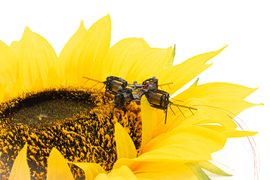
MIT researchers have flown an insect-scale flapping-wing robot that carries its own sensors and computing power, removing the external motion-capture cameras that have tethered microrobot research to the lab for over a decade. The work, led by electrical engineering and computer science professor Kevin Chen with co-corresponding author Jonathan How, was published November 18, 2026 in Science Robotics.
The robot weighs less than a paperclip, and the onboard electronics package adds just 244 milligrams. Four flapping wings, driven by artificial muscles, give it a lift-to-weight ratio of 1.9, while an inertial measurement unit, an optical flow sensor and a time-of-flight sensor let it hold a flight position accurate to within a few centimeters without any outside tracking system.
Key takeaways
- MIT's flapping-wing microrobot carries a 244-milligram sensor-and-compute package and flies with a lift-to-weight ratio of 1.9.
- It is the first insect-scale aerial robot demonstrated to be both sensory and compute autonomous, according to lead researcher Kevin Chen.
- Onboard sensors include an inertial measurement unit, an optical flow sensor and a time-of-flight sensor, reaching positional accuracy of a few centimeters.
- Researchers tested rudimentary pollination by guiding the robot with a joystick to land on a sunflower.
- The findings were published November 18, 2026 in Science Robotics, led by Kevin Chen with co-authors Yi-Hsuan Hsiao, Quang Phuc Kieu and Zhongtao Guan.
Microrobots this small have historically depended on motion-capture rigs bolted to a ceiling, a setup that confines them to a handful of labs worldwide and rules out any real-world task. Chen's team instead squeezed an IMU, an optical flow sensor and a time-of-flight sensor onto a microcontroller light enough for the robot to still lift off the ground, then tuned control algorithms to compensate for the noise and drift that come with such tiny, low-power hardware. The result holds steady in free flight with centimeter-level accuracy, a bar previously reached only with external cameras tracking reflective markers.
Why self-contained flight matters for robotics
Robotics researchers have chased autonomous insect-scale flight because the category promises access to spaces no larger robot can reach: crop canopies, collapsed building voids, pipe interiors and dense electronics enclosures. Until now, every demonstration of flight stability at this scale relied on an outside perception system, which meant the robot could never actually leave the lab. Chen's group has pursued the problem for years, previously showing flapping-wing robots that could recover from collisions and fly after wing damage, but compute and sensing remained the missing piece.
The team's early pollination test, using a joystick to send position setpoints while the robot navigated between plants and landed on a sunflower, hints at the commercial logic driving the research. Precision pollination, crop and pest surveillance, and confined-space industrial inspection are all tasks that current drones are too large or too disruptive to perform, and insect-scale robots could work in swarms where a single unit's loss is inconsequential.
What comes next
The researchers say the next steps involve extending flight endurance, which is currently limited by the tethered power delivery common to artificial-muscle actuators, and adding more autonomy so the robot can make navigation decisions without a human issuing setpoints. Competing efforts at Harvard's Wyss Institute and Delft University of Technology have pursued similar insect-scale platforms, but onboard compute at this mass has remained an open problem across the field. MIT's result gives other labs a tested architecture to build on rather than a one-off demonstration confined to a motion-capture volume.