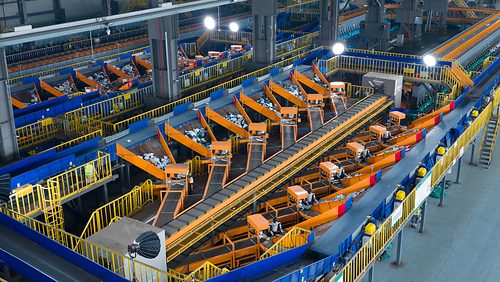
ROBOTERA now runs 45 humanoid robots on the parcel sorting floor at China Post's Hangzhou Postal District Center, what the company calls the largest humanoid robot testing deployment in Chinese postal operations so far.
The robots have been working since April 2026, and according to ROBOTERA's announcement, their throughput has climbed from an initial 500 to 600 parcels per hour to roughly 1,200 parcels per hour during peak testing periods, with operational accuracy exceeding 90%.
What exactly are the robots doing on the sorting floor?
The humanoids pick parcels off conveyor lines, reorient them so barcodes face the right way, and place them onto induction platforms that feed China Post's automated sorting system. They are also trained to spot irregularly shaped parcels, items too odd-sized or oddly packed for standard automated handling, and reject or redirect them instead of jamming the line.
That combination of picking, reorienting and exception-handling is the harder half of parcel sorting automation. Conventional conveyor and chute systems handle uniform boxes well, but they struggle with the mix of soft bags, irregular packages and mislabeled items that make up a meaningful share of real parcel volume, which is exactly the gap ROBOTERA is targeting.
Why did throughput more than double since the robots started?
ROBOTERA attributes the jump from 500-600 to roughly 1,200 parcels per hour to improvements in motion smoothness, recognition accuracy and handling precision made over the seven months since deployment began. That is a meaningful detail for the industry: it suggests the limiting factor for humanoid robots in logistics work is less about raw hardware capability and more about iterative software tuning once robots are already on a live floor.
A deployment running since April 2026 with steadily rising throughput numbers also gives ROBOTERA a harder data point than many humanoid robot demos, which tend to showcase short, staged tasks rather than months of continuous production use.
How does this compare to other humanoid logistics deployments?
ROBOTERA is not alone in chasing postal and warehouse work for humanoids. Chinese rivals and foreign players alike have been placing smaller fleets, often single digits to low dozens of units, into pilot programs at distribution centers and fulfillment warehouses over the past year. A 45-unit fleet operating for seven consecutive months puts ROBOTERA's China Post deployment toward the larger end of publicly disclosed humanoid logistics pilots to date.
China Post's Hangzhou branch has signaled it plans to extend automation further, adding intelligent sorting and security inspection systems across more of its operations, which suggests ROBOTERA's current deployment is a step toward a wider contract rather than a standalone pilot.
What should the industry watch for next?
The next milestone to watch is whether China Post scales the fleet beyond 45 units or extends humanoid deployment to other postal centers beyond Hangzhou. A steady accuracy rate above 90% combined with rising throughput over seven months gives ROBOTERA a case study it can use to pitch other logistics operators on humanoid robots for parcel handling, a job long dominated by fixed conveyor automation and manual labor.