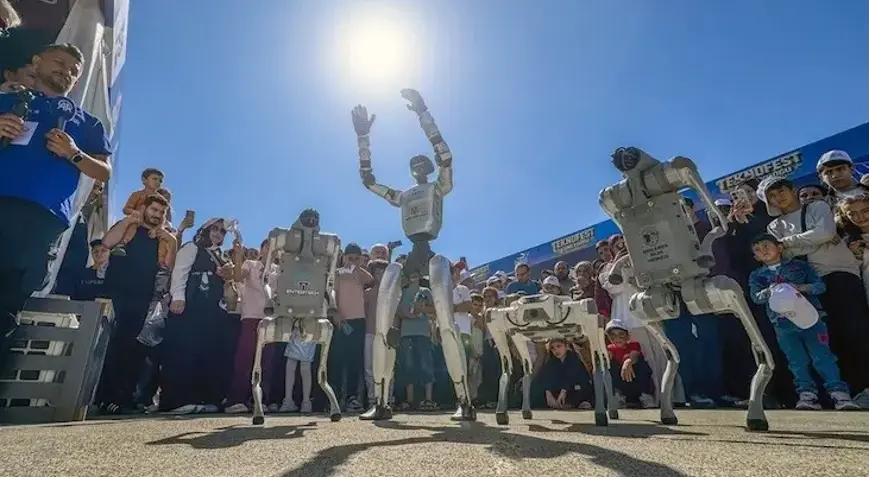
Türkiye has opened a grant program that will cover 50% of project costs for companies developing industrial humanoid robots, Industry and Technology Minister Mehmet Fatih Kacir announced on November 24, 2026. Applications run through the Ministry's online portal until December 31, 2026, and approved projects can run as long as 48 months, covering everything from design and prototyping to real-world deployment. Notably, the call carries no disclosed budget cap, an unusual choice for a government subsidy program.
The money targets the parts of a humanoid robot that are hardest to source domestically: torque-controlled actuators, harmonic reducers, servo motors, sensors, grippers, and the control and motion software that ties them together. Kacir framed the goal as strengthening Türkiye's capacity to manufacture advanced technology while cutting dependence on foreign suppliers for those components, according to Milliyet.
Why a subsidy matters more than a demo
Humanoid robots look like a software story on stage, but the real bottleneck sits in a short list of mechanical parts made by a handful of suppliers, mostly concentrated in Japan, Germany and China. Harmonic reducers and torque-controlled actuators are costly to design and brutal to manufacture at the precision a humanoid joint demands. Countries without an existing industrial base in those components are effectively locked out of building competitive robots, no matter how capable their AI models are.
That is the gap Türkiye is trying to close with public money rather than waiting for its domestic robotics sector to accumulate the capital on its own. A 50% match lowers the risk for any company willing to attempt a reducer or actuator program that would otherwise take years to pay back. The absence of a stated budget ceiling suggests Ankara wants the program to scale with however many credible applicants show up by year-end, rather than rationing a fixed pool among a handful of winners.
There is a geopolitical layer, too. Supply chains for precision robot components have become a point of friction as humanoid robot demand climbs globally, and nations that manufacture none of those parts are exposed to price swings and export decisions made elsewhere. Building domestic capacity, even a small amount, gives Türkiye negotiating leverage it does not currently have.
How this compares to other national pushes
Türkiye is late to this race but not alone in running it. South Korea's K-Humanoid Alliance pools government and corporate money behind a similar goal of domestic actuators and gearboxes. China has spent years subsidizing its own reducer and servo motor makers, which is part of why Chinese suppliers now compete on price with Japanese incumbents like Harmonic Drive. The European Union and individual member states have floated comparable component-sovereignty programs, though usually with narrower scope and a hard spending cap.
Where Türkiye's program differs is its lack of a ceiling and its explicit inclusion of full-system deployment, not just component R&D. That makes it friendlier to a company trying to build an entire humanoid platform rather than one niche part. The trade-off is execution risk: a 50% match is only useful to firms that can fund the other half, and Türkiye's robotics sector is smaller and less capitalized than South Korea's or China's. Without a parallel push to get venture or corporate capital into the space, the grant could end up subsidizing a handful of well-funded incumbents rather than seeding a broad domestic supply chain.
The December 31 deadline gives applicants roughly five weeks to submit, which is tight for a program covering hardware development. How many credible proposals materialize in that window will say more about the state of Türkiye's robotics industry than the subsidy terms themselves.