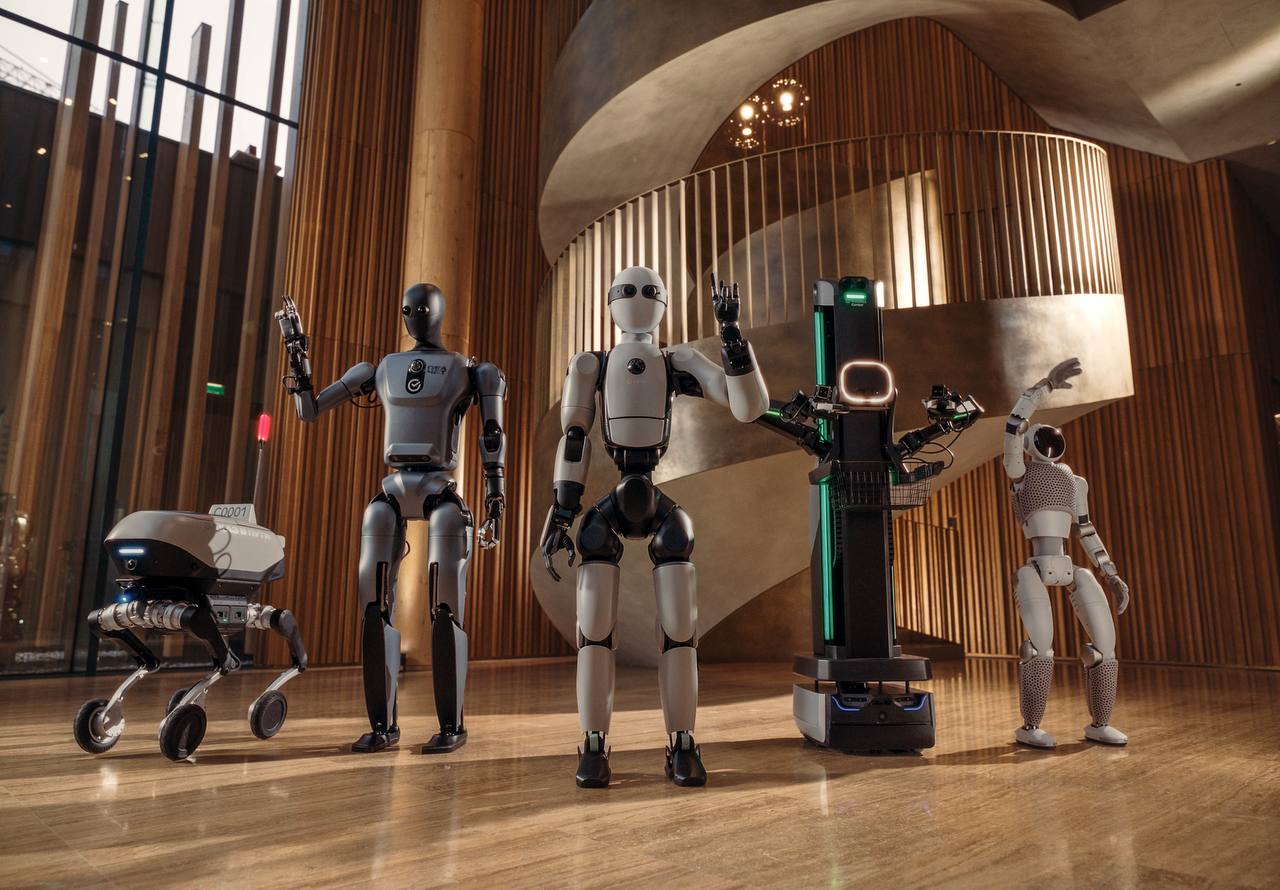
Sber unveiled three new robotic platforms at the AI Journey conference on November 27: an upgraded humanoid called Green 2.0, an athletic robot named Yuni and a delivery robot currently piloting in a Moscow district. All three run on GreenVLA 2.0, the Russian bank's proprietary foundation model for physical AI, according to Electronics Media.
Sber CEO Herman Gref described the goal plainly: \"Our goal is for these robots to independently carry out tasks that are useful to humans.\" The company said it is expanding in-house component manufacturing at its Robotics Center to support the new lineup.
What can these robots actually do?
Green 2.0 is a humanoid built for manipulating objects and navigating spaces, with more degrees of freedom than its predecessor, higher arm payload capacity and coordinated control across arms, legs and torso so it can carry out multi-step action sequences rather than isolated moves. Yuni is positioned differently: an \"athletic\" robot meant to perform dynamic movements like choreography and acrobatics, which Sber frames as a way to develop and showcase balance, body control and movement coordination, skills that transfer to less flashy industrial tasks.
The delivery robot is the most immediately commercial of the three. It uses a wheeled-legged design to handle curbs, stairs and other urban obstacles, is built to run in rain and snow, and is already in pilot testing in a Moscow district, with Sber describing door-to-door delivery as a future goal rather than a current capability.
Why put three different robots on one AI model?
GreenVLA 2.0 is Sber's attempt at a single foundation model that works as the control backbone across humanoid, athletic and wheeled-legged form factors, rather than building separate software stacks for each robot. The pitch mirrors a trend seen elsewhere in the industry, where companies like XPeng have said their humanoid and robotaxi products share one underlying AI brain: a unified model is meant to let improvements in one robot's training data, such as balance tuning from Yuni's acrobatics, carry over to Green 2.0's manipulation tasks or the delivery robot's terrain handling.
Sber is better known globally as Russia's largest bank than as a robotics company, but it has been investing in a dedicated Robotics Center and has now shown three distinct hardware platforms under one AI umbrella at a single event. No pricing, production timeline or commercial customer names were disclosed for Green 2.0 or Yuni, leaving the Moscow delivery pilot as the only platform with a concrete deployment to point to.