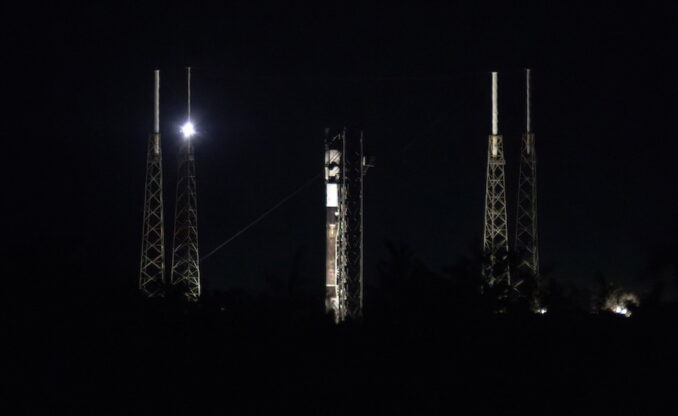
SpaceX pushed the reusability envelope again on Tuesday, launching a Falcon 9 rocket from Cape Canaveral with its fleet-leading first-stage booster, tail number B1067, on a record-breaking 37th flight. Liftoff from Space Launch Complex 40 was scheduled for 5:33 a.m. EDT (0933 UTC), sending the vehicle north-east with 29 Starlink 10-49 broadband satellites bound for low Earth orbit.
A booster that has quietly rewritten the reuse ceiling
B1067 entered service in June 2021 and has become the workhorse of SpaceX's Cape Canaveral fleet. Each mission on the booster has pushed past the original 10-flight lifetime SpaceX certified for the Block 5 design, then past 20, and now 37. Nearly 8.5 minutes after liftoff the first stage targeted a landing on the droneship A Shortfall of Gravitas, which would mark the vessel's 165th recovery and Falcon's 654th booster landing overall.
Starlink now above 11,000 satellites
The Starlink 10-49 mission adds another batch of user-terminal satellites to a constellation that exceeded 11,000 spacecraft in low Earth orbit earlier in August. The company has already flown 44 of its 76 Starlink missions from Vandenberg Space Force Base this year, with the Cape Canaveral workforce increasingly reassigned to Starship preparations, so Tuesday's flight could be the last Starlink launch from Florida for a while.

Weather and the wider 2026 cadence
The 45th Weather Squadron forecast a 90 percent chance of favourable weather at Tuesday's window, watching only for a low probability of cumulus and anvil-cloud interference. The launch continues a landmark run for SpaceX: the company crossed 100 orbital missions of 2026 last week, and later this month is scheduled to fly NASA's Nancy Grace Roman Space Telescope on a Falcon Heavy from Florida.
Reusability at scale
SpaceX's cadence has grown around a small fleet of high-flight boosters that repeatedly return to the droneship, get refurbished, and fly again within weeks. B1067 sits at the top of that fleet and is now a de-facto proving article for how long an orbital-class first stage can be certified to fly with only regular inspection and part replacement. Booster longevity is central to SpaceX's economics, and by extension to the pricing pressure it puts on rivals rebuilding their own reusable-rocket programs after Blue Origin's New Glenn pad-36 setback.
Reporting based on coverage from Spaceflight Now.