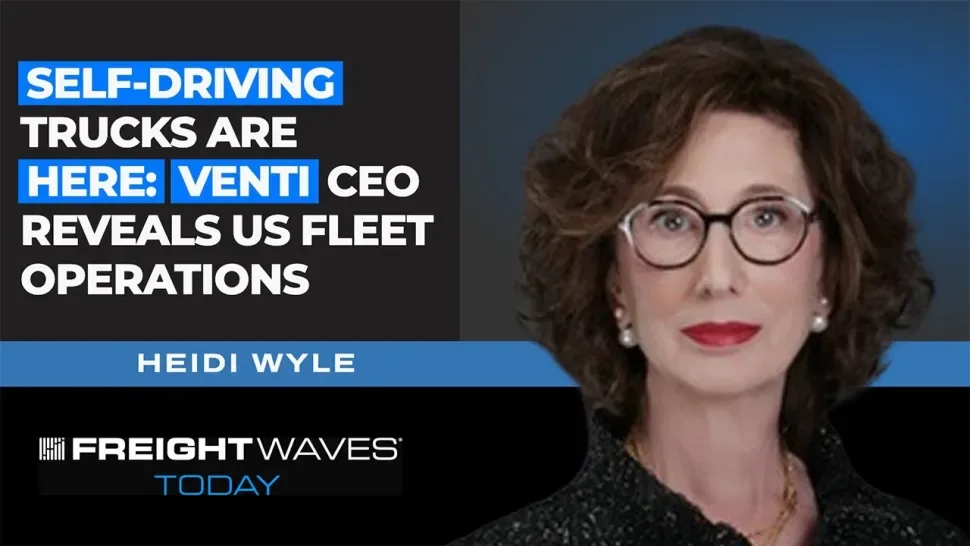
About 60 autonomous container trucks are now moving freight around the clock in intermodal rail yards in California and Texas, with no reported safety incidents, according to Venti Technologies CEO Heidi Wyle. Speaking to FreightWaves, Wyle said the trucks are running in full production, not pilot mode, and are already beating human productivity benchmarks on the routes they cover.
"We are running, every day, 24/7, in full production operations, exceeding human productivity," Wyle said. The trucks shuttle shipping containers between stacks, cranes and trains inside fenced yard facilities, a job that looks nothing like highway trucking but is just as critical to keeping goods moving through the supply chain.
How does a truck drive itself in a yard?
Venti doesn't build its own trucks. Its software gets installed on vehicles the customer already owns, which keeps hardware costs down but forces the system to work with whatever sensors and drivetrains already exist on the lot. The company says the full software platform costs $70 million to $80 million to deploy, and it leans on a mix of lidar, cameras and ultrasonic sensors rather than betting everything on one sensor type.
Yards are also a far more forgiving environment than public roads. There are no pedestrians wandering in from a side street, no oncoming traffic and a limited, repeatable set of maneuvers: backing a container under a crane, parking a chassis in a numbered slot, threading between stacked containers without a human spotter. That structure is exactly why yards, not highways, have become the proving ground for driverless trucking. Wyle told FreightWaves that fully autonomous, unsupervised trucking on public roads is "probably 7 to 10 years out," which makes the contained yard environment the near-term business.
Why is this expanding now?
Venti says roughly 85% to 90% of its core software carries over between applications, meaning the code built for ocean port terminals only needed about two months of additional engineering to work in a rail-yard setting. That reusability is central to the company's pitch: rather than starting from scratch with every new customer, it is layering incremental changes on top of a proven base.
The company's first commercial fleet launched in Singapore, the world's second-largest container port, where it has now operated for nearly three years. A second Singapore fleet of 30 vehicles is set to launch later this year. Venti says its systems have collectively moved hundreds of thousands of containers without a reportable safety incident, a track record it is now using to court additional US customers.
Venti already has agreements in place with several Class I US railroads and says it is in discussions with the rest of the industry. For yard operators, the pitch is financial as much as technical: Venti projects 40% to 70% in transportation cost savings for customers that adopt the technology, a figure that matters in an industry where yard operations touch an estimated $55 billion in goods moved daily through US supply chains.
Wyle expects broad US rail-yard deployment within two years. That timeline sits well ahead of robotaxi-style driverless trucking on open highways, which remains constrained by weather, traffic density and regulatory approval across state lines. For now, the yard is where autonomous trucking has quietly gone from demo to daily shift work.