
Delivery drone operator Zipline became the only major US player to answer on-the-record safety questions from industry outlet DroneXL this month, disclosing aircraft weights, parachute logic and camera behavior while Amazon Prime Air and Alphabet's Wing declined to respond across multiple deadlines. The exchange, published September 16, 2026, opens up a rare set of technical specifics on a delivery-drone fleet at a moment when regulators, cities and residents are scrutinizing routine backyard flights.
What Zipline actually disclosed
Zipline said its second-generation Platform 2 aircraft weighs 55 pounds empty and 63 pounds fully loaded with an 8-pound payload, cruising at roughly 70 mph. The company described dual-parachute redundancy for both the aircraft and the delivery pod, more than 500 safety checks per second in flight-critical software, and no single point of failure in the flight stack. It stated flatly that "all cameras are in a fixed position and cannot pan, tilt, or zoom," a point community groups had pressed on. Zipline deferred incident counts, decibel readings, weather limits and liability questions to a broader safety document it said it would publish separately.
Amazon Prime Air and Wing skipped the questions
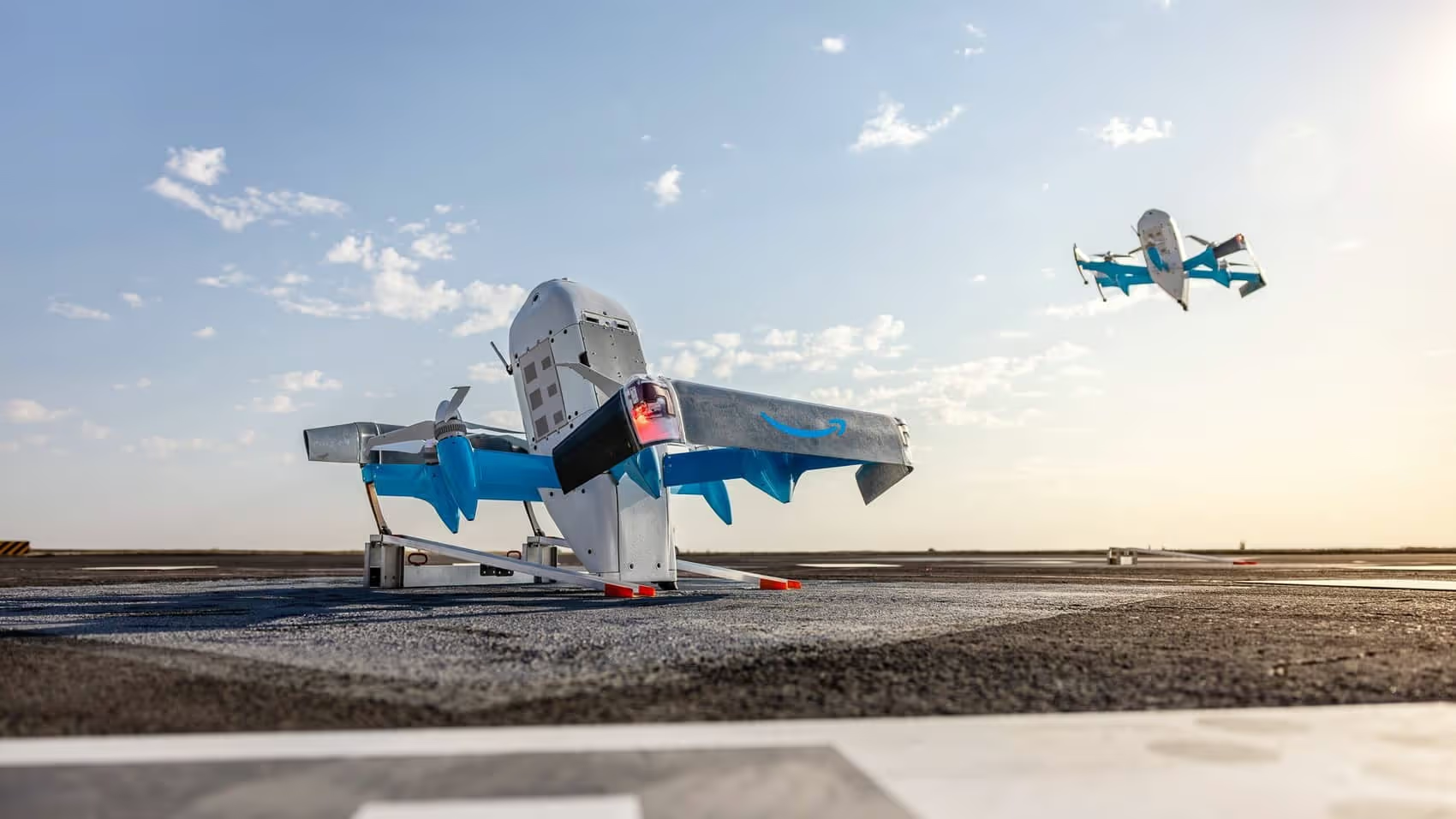
DroneXL says its 25-question set was sent to Amazon Prime Air three times before deadline, with no substantive response, and that Wing declined 30 questions in a parallel round. Amazon's MK30 aircraft is the heaviest of the trio at 83 pounds and drops packages from about 13 feet with no parachute, according to publicly reported specs, and has been linked to seven US incidents in DroneXL's running tally. Wing, which claims more than 1 million deliveries worldwide, has recorded no US incidents in that same log.
Why the transparency gap matters
Delivery drone deployment has moved past pilot phase in the US, with Amazon announcing plans to bring Prime Air to nearly 500 US cities, Wing scaling residential coverage and Zipline signing a headline Uber Eats partnership targeting 1 million deliveries a day by 2029. Municipal opposition, however, has hardened in cities where MK30s are already flying and where residents have complained about noise and low-altitude passes. Analysts say that operators willing to publish detailed specs will have an easier time defending their airspace authorizations, especially as the FAA works through Part 108 rulemaking on beyond-visual-line-of-sight operations.
Regulators watching closely
The FAA, DoT and NTSB have all leaned harder on drone-delivery data in 2026 following DroneXL's public tracker of Amazon, Wing and Zipline hubs and incidents. Zipline's decision to answer, however partially, will pressure Amazon and Wing to publish similar details if they want to expand into new metros without slowing local approvals. Adjacent air-taxi operators are watching too, as Matternet's new autonomous service-parts network with AVI-SPL arrives in enterprise deployments where safety documentation is table stakes.
Reporting based on coverage from DroneXL and Commercial UAV News.