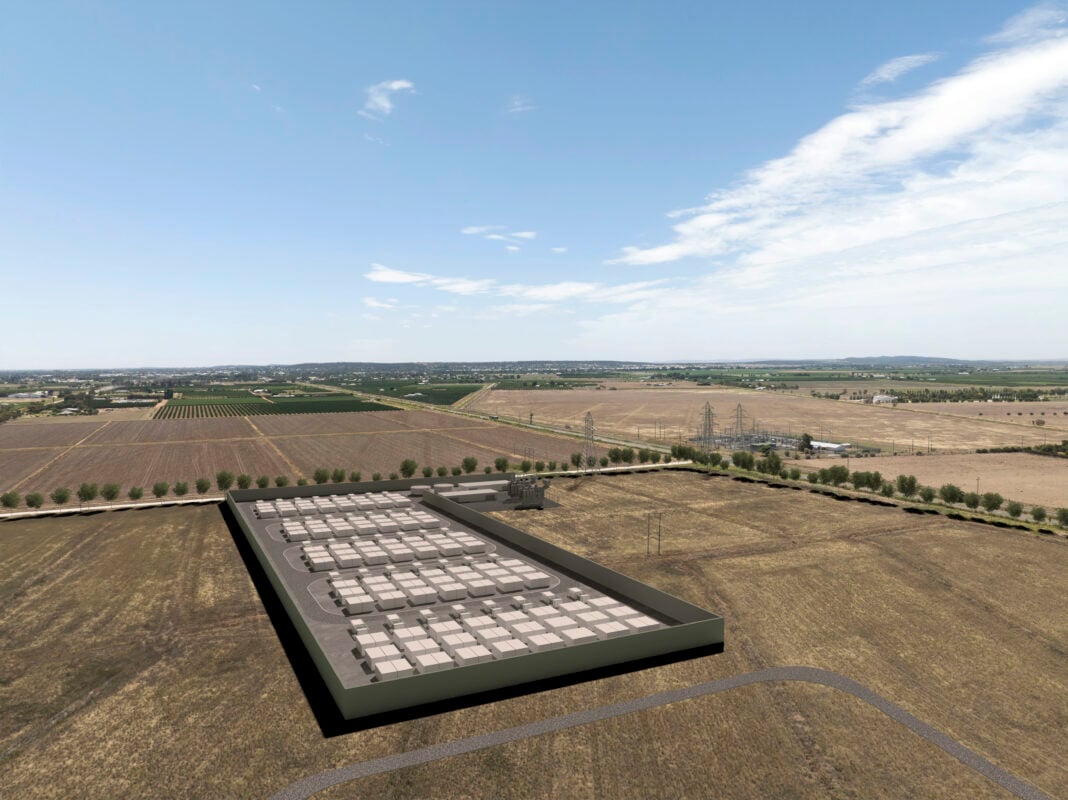
Australian battery storage developer Eku Energy, jointly owned by Macquarie Asset Management and the British Columbia Investment Management Corporation, has submitted its 1,000 MWh Griffith BESS for environmental assessment under Australia's Environment Protection and Biodiversity Conservation (EPBC) Act — growing the project's contracted scope by 200 MWh and confirming a 10-hour duration.
From 800 MWh to a 10-hour benchmark
The proposed facility will have a nominal power output of 100 MW and 1,000 MWh of energy storage capacity, located on a 9.33-hectare site in Yoogali, around 5 km east of Griffith, New South Wales. The disturbance footprint covers 7.49 hectares, and the BESS will be co-located alongside the proposed 15 MW Yoogali solar PV plant. The site will connect to the National Electricity Market via 132 kV underground cables to Transgrid's Griffith Substation, with a new switch bay being installed at the substation.

Griffith originally secured a 14-year Long-Term Energy Service Agreement (LTESA) from AEMO Services in February 2025 as a 100 MW / 800 MWh, 8-hour-duration system. The EPBC submission upsizes that contracted design by 200 MWh, putting Griffith among the longest-duration standalone battery projects currently moving through approvals in the NEM. The Belah and Monduran projects in Queensland (both 400 MW / 1,600 MWh, 4-hour duration) sit alongside Griffith in Eku's pipeline.
Long-duration storage hits its stride
Eku has argued that the NEM's market design needs to evolve to properly reward long-duration storage assets for inertia, frequency control and voltage support — revenue streams that currently sit outside the arbitrage and FCAS markets that dominate operational BESS economics. A 10-hour Griffith battery, positioned in a solar-heavy region, would be well-placed to capture extended evening dispatch windows as PV output rolls off and demand stays elevated.
9 GWh by 2028
Eku has set a target of 9 GWh of global operating storage capacity by 2028, anchored by a deepening Australian portfolio. Griffith is expected to enter operation in 2028. The submission lands in a busy week for global battery storage, with DNV independently verifying Fluence's 98.7% fleet availability, Twaice deploying analytics on a 282 MWh German BESS and Aquila closing merchant BESS financing in Germany.
Reporting based on coverage from Energy-Storage.News and Reneweconomy.