Google's Willow Quantum Chip Learns From Its Own Errors, Cuts Logic Faults 20%

A Google-led team says its reinforcement learning framework continuously calibrates over 1,000 hardware parameters on the Willow quantum processor, cutting logical error rates 20% and keeping performance 3.5x more stable under drift.

Key Takeaways

  • Google Quantum AI embedded a reinforcement learning agent in Willow's error-correction loop, using every detection event as a training signal to adjust over 1,000 hardware parameters without halting computation.
  • The framework cut logical error rates about 20% beyond exhaustive expert tuning on distance-5 and distance-7 surface codes and a distance-5 color code, published in Nature and unveiled July 10.
  • Under artificially injected drift, hardware-only adaptation reduced logical errors 24%; adding classical decoder adaptation improved that to 31% and made performance 3.5x more stable.
  • Simulations of distance-15 surface codes with roughly 40,000 control parameters suggest optimization speed stays largely independent of system size because errors are corrected locally.
  • Limits remain: active exploration can perturb single-shot computations under rapid drift, and the implementation relies on proprietary Google software, though the approach should transfer to other quantum modalities with error-detection streams.

Google's Willow Quantum Chip Learns From Its Own Errors, Cuts Logic Faults 20%

Google Quantum AI has demonstrated a superconducting quantum computer that continuously learns from its own error-correction data to keep itself calibrated while it computes, an advance the company says could unlock the long, uninterrupted workloads required for fault-tolerant quantum computing. The work, published this month in Nature, was run on Google's Willow processor and unveiled July 10.

Reinforcement Learning Replaces Downtime

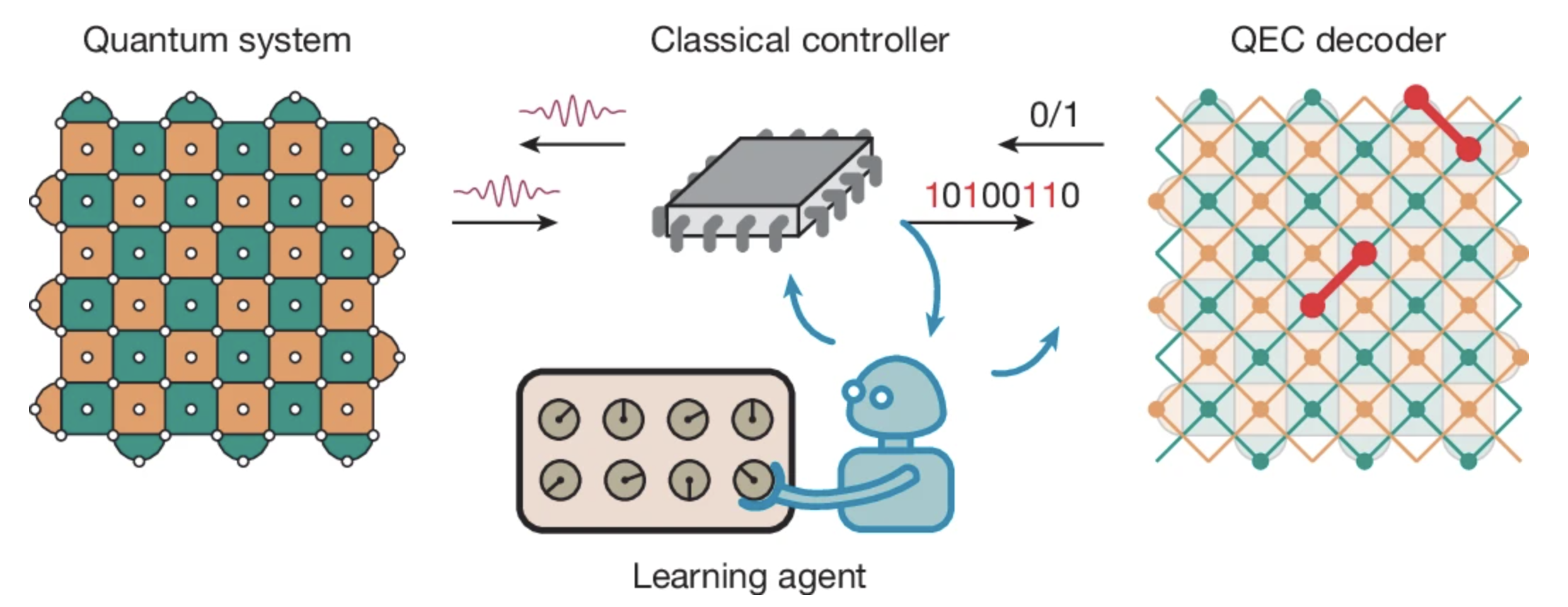
Today's quantum computers periodically halt calculations so engineers can retune microwave pulse amplitudes, frequencies, coupling strengths and hundreds of other analog parameters that drift as hardware ages and temperatures shift. Google's team, led by researchers at its Santa Barbara Quantum AI lab, wired a reinforcement learning agent into the error-correction loop itself. Every detection event produced during surface-code and color-code error correction becomes a training signal, and the agent adjusts more than 1,000 hardware parameters on the fly without stopping the machine.

Google Willow quantum processor illustration

What The Numbers Show

On distance-5 and distance-7 surface codes plus a distance-5 color code, the reinforcement learning framework cut logical error rates by roughly 20% beyond exhaustive expert tuning, and made logical performance 3.5 times more stable under artificially injected hardware drift. Under that drift regime the team reports a 24% cut in logical error rate on hardware controls alone; when the classical decoder parameters were also adapted, that improved to a 31% reduction and a 3.5x stability gain. The paper also sets new benchmark performance for both surface-code and color-code error correction on superconducting hardware.

Scaling And Limits

Beyond the physical demonstration, the group simulated distance-15 surface codes involving roughly 40,000 control parameters and reports that the framework's optimization speed remains largely independent of system size because errors are corrected locally. The authors caution that active exploration can itself perturb single-shot computations if drift is rapid, and note the current implementation still leans on proprietary Google software. Even so, the technique should apply to other quantum modalities that expose error-detection streams, giving competitors from Oratomic to Pasqal and neutral-atom shops a template to copy.

Why It Matters For Fault Tolerance

Fault-tolerant quantum computers will need to run correctly for days or months, not minutes, and the calibration overhead has been one of the least-discussed roadblocks in the field. Google's paper effectively hands off some of that maintenance from humans to software running inside the error-correction loop, following the recent White House quantum summit pledge to reach fault tolerance by 2028 and Diraq's 300mm CMOS silicon-spin milestone earlier this month.

Reporting based on coverage from Nature, The Quantum Insider, Quantum Zeitgeist and Google Research.

Category: Machine Learning

Related Articles

Frequently Asked Questions

How does Google's Willow chip learn from its own errors?

A reinforcement learning agent is wired into the error-correction loop, treating every detection event from surface-code and color-code error correction as a training signal and adjusting more than 1,000 hardware parameters, like microwave pulse amplitudes, frequencies and coupling strengths, on the fly without stopping the machine.

How much did the technique improve performance?

It cut logical error rates roughly 20% beyond exhaustive expert tuning and made logical performance 3.5 times more stable under injected drift; hardware-only adaptation gave a 24% error reduction, rising to 31% when decoder parameters were also adapted.

Why does self-calibration matter for fault-tolerant quantum computing?

Fault-tolerant machines must run correctly for days or months, but current systems halt for periodic recalibration as parameters drift. Moving calibration into software inside the error-correction loop removes that downtime, a little-discussed roadblock to long uninterrupted workloads.

Can the approach scale or be used beyond Google's hardware?

Simulated distance-15 surface codes with about 40,000 parameters showed optimization speed largely independent of system size, and the authors say the technique should apply to other modalities exposing error-detection streams, including neutral-atom players like Oratomic and Pasqal, though it currently depends on proprietary Google software.