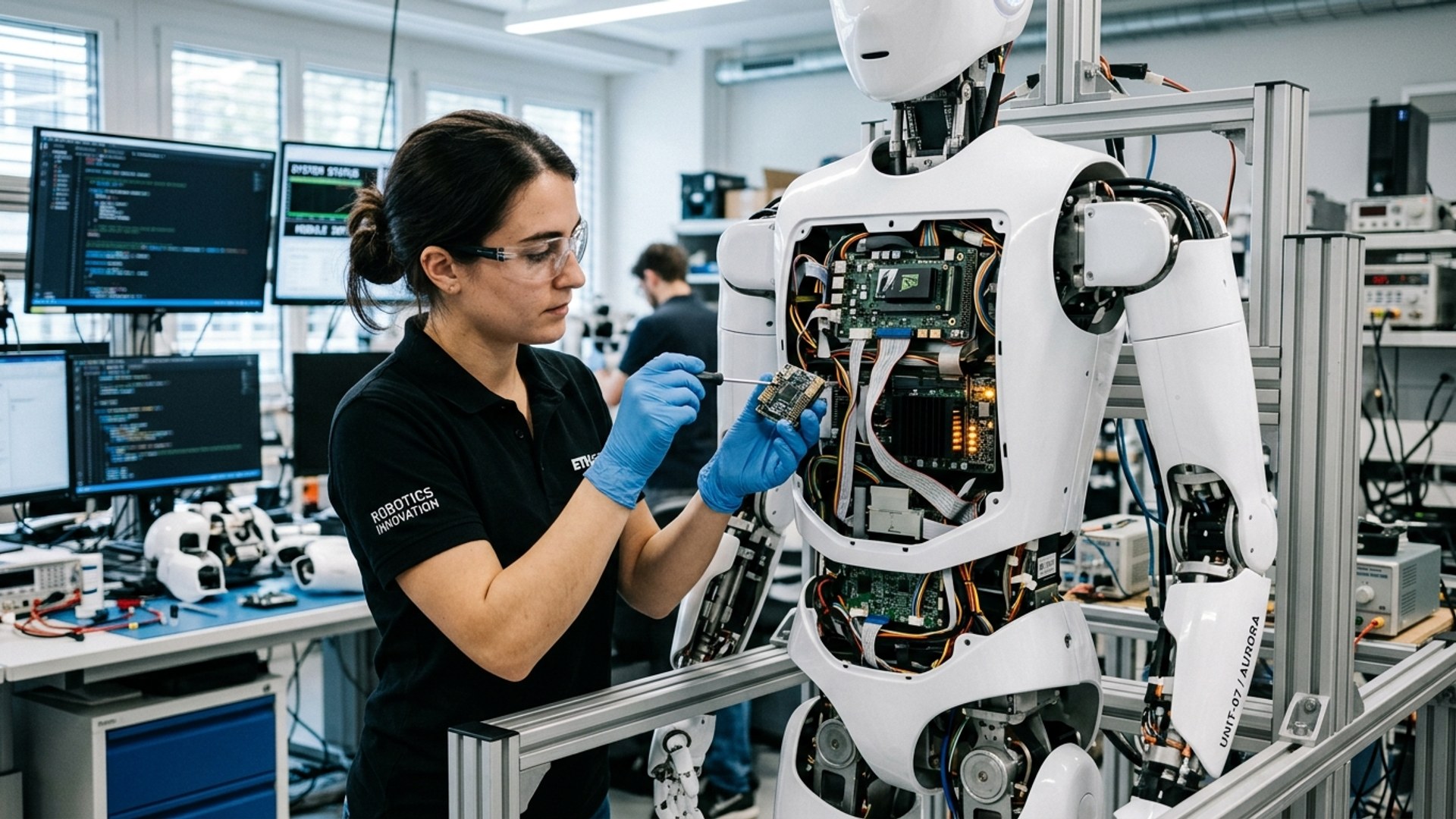
German cognitive robotics company NEURA Robotics and Italian embedded-computing group SECO announced a strategic partnership on 7 September 2026 under which SECO will design, engineer and manufacture electronic compute modules for NEURA's cognitive robots, including the humanoid 4NE-1. The joint release, datelined Metzingen, Germany and Arezzo, Italy, framed the deal as an effort to industrialise and scale Physical AI from Europe.
Dragonwing Compute Modules For NEURA's Smart Limbs
The modules integrate Qualcomm Dragonwing processors and fit into NEURA's distributed Brain and Nervous System architecture, in which sensing and compute are pushed out to the joints, sensors and contact points under the company's Smart Limbs concept. Qualcomm's Dragonwing Robotics silicon supplies the on-device AI throughput, power efficiency and low-latency control that the decentralised design requires, while SECO's job is to engineer and industrialise the corresponding modules for scalable production. The partnership extends a broader Brain and Nervous System reference-architecture collaboration NEURA and Qualcomm announced in March 2026 as part of NEURA's $1.4B Series C round.
Semiconductor Focus And An Italian NEURA Gym
Beyond the compute modules, the two companies are targeting semiconductor and electronics manufacturing itself. NEURA and SECO plan to use production data gathered as NEURA robots are deployed in real industrial settings to train new Physical AI automation for chip and electronics factories worldwide. The next steps include opening a NEURA Gym in Italy, the company's first physical training hub in Southern Europe, alongside the 3,000 square-metre NEURA Gym opened with RWTH Aachen in July, where robots practise real tasks in authentic environments to generate training data that simulation alone cannot replicate.

A European Physical AI Supply Chain
NEURA describes Physical AI as resting on three layers: sensing, compute and cloud infrastructure. The partnership commits the compute layer to Europe, with SECO's Arezzo-based manufacturing base becoming a stated link in what both companies call a resilient European supply chain. The 4NE-1, one of the platforms set to carry the modules, is 180 centimetres tall, weighs 80 kilograms, moves at up to 5 km/h and handles payloads from 10 to 100 kilograms, with full-body sensing, exchangeable forearms and wheeled variants for factory floors. The move follows NEURA's acquisition of ADLATUS for autonomous cleaning and its IFA 2026 Berlin keynote putting the Neuraverse and 4NE-1 centre stage, and it plays into wider efforts including Europe's push to certify humanoids under EN 18031.
"Physical AI will not be built by one company alone," NEURA founder and CEO David Reger said in the announcement, framing the deal as an ecosystem bet across sensing, compute, cloud and industrialisation. SECO chief executive Max Mauri said combining the two companies' expertise with Qualcomm's platforms could yield solutions far beyond a single factory or application. Nakul Duggal, Qualcomm Technologies' EVP for Automotive, Industrial and Embedded IoT and Robotics, said the addition of SECO would help accelerate the path to reliable large-scale production.
Reporting based on coverage from Unite.AI, NEURA Robotics, SECO and MilanoFinanza.