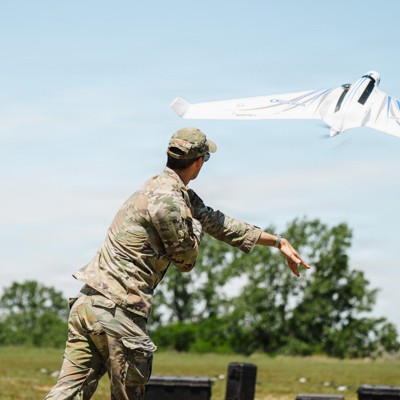
The Senate Armed Services Committee has cleared a $1.15 trillion fiscal 2027 National Defense Authorization Act that gives the Pentagon explicit permission to stand up a new four-star Robotic and Autonomous Systems Combatant Command, the first new combatant command since U.S. Space Command was reestablished in 2019.
An 18-9 vote and a permissive amendment
The committee voted 18-9 on June 11 to advance the bill, with senators describing the debate as "spirited." The combatant-command language is permissive rather than mandatory, meaning the Defense Department may—rather than must—use the authority. If exercised, the new command would consolidate planning, doctrine and force employment for unmanned aerial, ground and maritime systems and would be led by a four-star officer, modeled after Ukraine's standalone unmanned systems branch.
Streamlined acquisition for unmanned systems
To accelerate fielding, the legislation grants the new headquarters special test-and-evaluation authorities along with limited acquisition powers. Backers argue that current Pentagon programs are spread across the services and DARPA, slowing fielding of capabilities such as long-range reconnaissance drones and medium unmanned surface vessels. A consolidated command would have authority to set test priorities and steer money toward proven prototypes.

Wider $1.15T defense bill
The combatant-command authorisation sits inside a broader top-line that includes troop pay adjustments, a procurement boost for unmanned vessels and continued investment in counter-drone tools. Senators also folded in language reinforcing the U.S. Army's lead role on counter-UAS standards, complementing recent steps on classified AI partnerships with major tech vendors.
What happens next
The bill now heads to the full Senate, where amendments could expand or narrow the new command's remit before conference negotiations with the House. If the authority survives and the Pentagon acts on it, the Robotic and Autonomous Systems Combatant Command would mark the most consequential reorganisation of unmanned warfare since the post-9/11 surge in remotely piloted aircraft.
Reporting based on coverage from Defense One, DefenseScoop, Breaking Defense and Air & Space Forces Magazine.