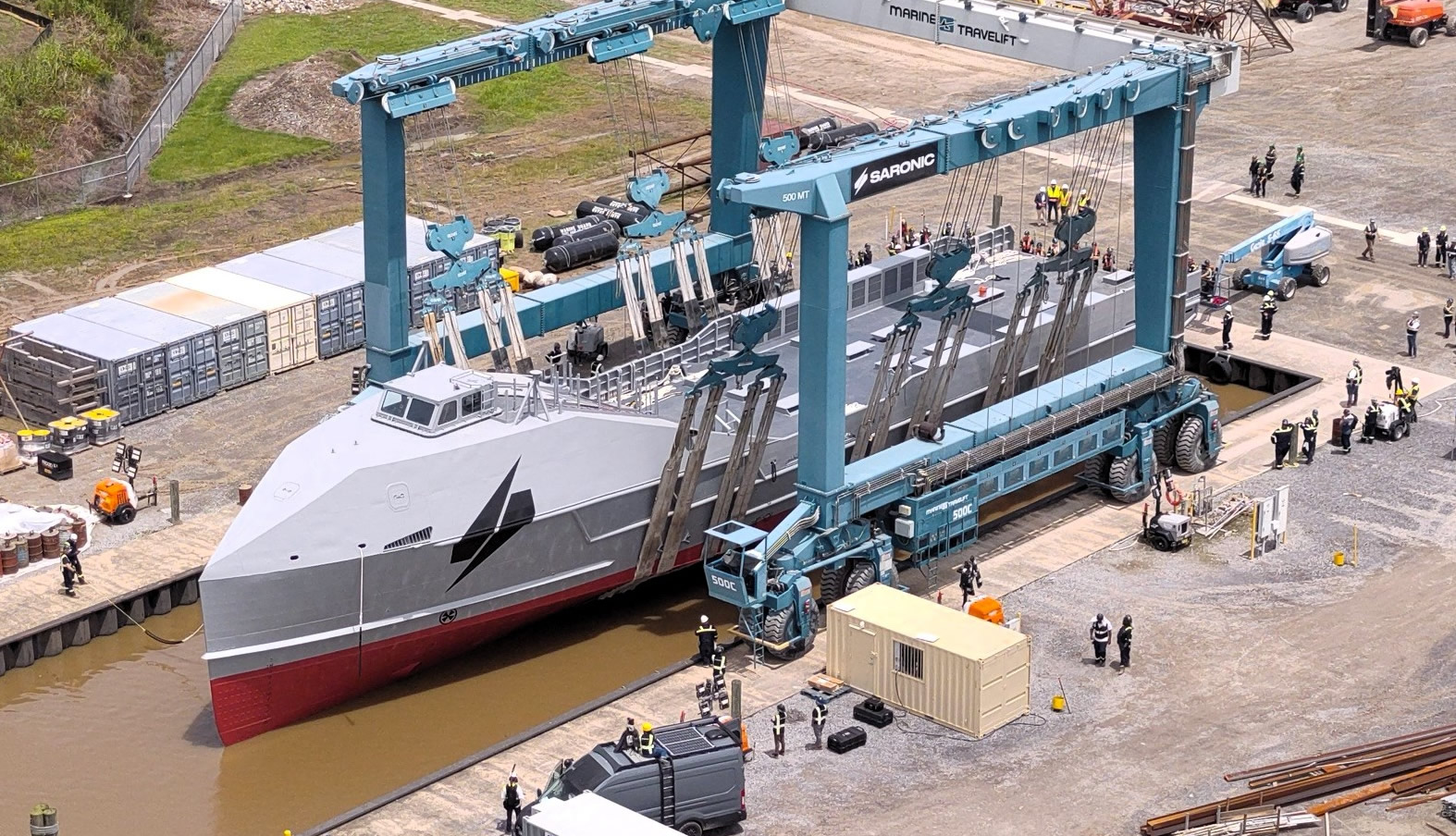
Saronic Technologies announced the launch of its first Marauder Medium Unmanned Surface Vessel (MUSV) on May 29, 2026, putting a new 150-foot autonomous ship into the water at the company's Franklin, Louisiana shipyard. The vessel is the largest in Saronic's autonomous fleet to date and is designed for dual-use defense and commercial missions far from shore.
From Design to Sea Trials in Under a Year
Saronic took the first Marauder hull from initial design to on-water trials in less than one year, a pace company leadership described as unmatched in American shipbuilding since World War II. "Designing, building, and launching an entire new class of ships in under a year is a feat the American shipbuilding industry hasn't seen in generations," said Dino Mavrookas, Co-Founder and CEO of Saronic. He attributed the speed to keeping design, manufacturing, and autonomy development in-house at a single integrated facility.
The second hull was flipped in March 2026 and is now being outfitted with mechanical, electrical, and autonomy systems, while the third and fourth hulls are already under construction. Saronic says work on the second hull is progressing 25 percent faster than the first.
Specifications Built for Long-Range Missions
Marauder has a top speed of more than 25 knots and a range of up to 5,400 nautical miles. Its 150-metric-ton payload bay is configurable to accept up to four 40-foot or eight 20-foot ISO containers, allowing the platform to be reconfigured for logistics, research, maritime domain awareness, or persistent intelligence, surveillance, and reconnaissance (ISR) without modifying the hull.
The vessel can operate fully autonomously or under remote human supervision. A software-based fleet-intelligence platform gives operators continuous telemetry, vessel-state, and subsystem visibility, with alerting, logging, and historical replay for diagnostics. Saronic says Marauder is the first ship designed and built end-to-end for autonomy, with every hardware component exposed to software for monitoring and actuation.
Production Capacity Designed for a Fleet
With expanded capacity targeted for completion by the end of 2026, the Franklin shipyard will be capable of producing up to 20 Marauders per year. "That production rate is what turns autonomous ships from a prototype into a program," the company said in its release. The integrated approach also leverages modern aluminum shipbuilding techniques, modular construction, and commercial components selected for production scalability.
Context: A Crowded Unmanned Surface Race
Marauder enters a fast-moving market. The US Navy this week advanced seven MUSV designs into its prototype phase, with Saronic among the contenders. Earlier in May, HII showcased its ROMULUS autonomous warship at a combined naval event, while Navantia unveiled its LASV75 uncrewed warship concept for hybrid fleets, and L3Harris secured a deal to equip US Navy submarines with Iver4 900 AUVs. Across the board, both established primes and venture-backed challengers are racing to deliver autonomous maritime platforms at production scale.
What to Watch Next
Saronic has not disclosed initial customers for Marauder or the timeline for sea-acceptance trials, but the company has positioned the platform to serve both Pentagon programs and commercial operators. With three additional hulls already in production and a shipyard expansion under way, the next milestone will be the first multi-vessel fleet deployment and the maturity of the human-on-the-loop intelligence platform that ties them together.
Reporting based on coverage from Naval News, USNI News, and WorkBoat.